Facelift
Including mini facelift and neck lift

A facelift is surgery that lifts sagging facial tissue through skin incisions and removes loose, excess skin.
It may be considered when sagging skin and tissue, deep wrinkles, and loose skin have blurred the contours of the face.
Facelift at a glance
- Surgery time
- 2 hours or more
- Anesthesia
- IV sedation
- Compression band
- 24 hours a day for 7 days
- Stitch removal
- 7–10 days
- Swelling & bruising
- 1–2 weeks
- Return to daily life
- 1–2 weeks
These may vary depending on the extent of surgery (mini facelift or neck lift) and the individual.
Quick answer
When is a facelift recommended?
A facelift may be considered when sagging skin and tissue, deep wrinkles, and loose skin have blurred the contours of the face. This sagging often comes with jowls along the jawline and beside the mouth, and deeper nasolabial folds (smile lines).
What is a facelift?
A facelift is surgery that lifts sagging facial tissue through skin incisions and removes loose, excess skin. At Steady Plastic Surgery, we release the sagging fascia layer beneath the skin (the SMAS layer), pull it back into place, and then remove the excess skin. The extent of the incision and release is planned individually according to the degree of sagging.
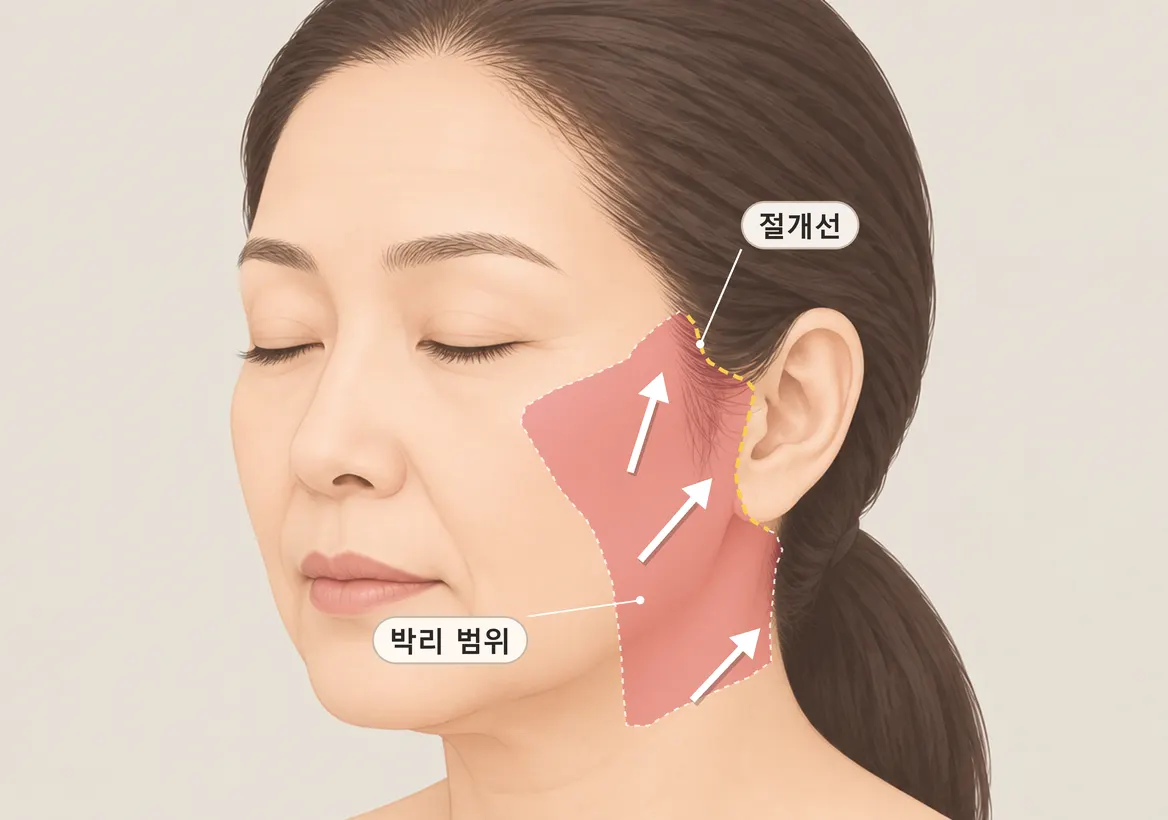
When a facelift may be needed
- Deep wrinkles and loose skin have blurred the contours of the face
- Jowls along the jawline or beside the mouth
- Sagging cheeks have deepened the nasolabial folds
- There is a lot of loose skin that needs to be removed as well
- The skin under the chin and on the neck has loosened
How are a mini facelift and a neck lift different?
A mini facelift lifts sagging tissue in the same way as a facelift, but for relatively mild sagging the extent of the incision and release is reduced. A neck lift extends the lift to the loose skin and sagging tissue under the chin and on the neck, and is performed when sagging below the jawline and on the neck occur together. The extent of surgery is decided during the consultation after checking the degree of sagging in the cheeks, jawline, and neck.
In a study of identical twins comparing short and full incisions, there was no difference in results at 1 year, while a difference appeared in the neck area at about 5 years (Antell et al., 2016).
How a facelift is performed
- 1
Incision design
The extent of the incision line is planned according to the degree of sagging.
- 2
Release
The fascia layer beneath the skin (the SMAS layer) is released, and the extent of the release is also planned according to the degree of sagging.
- 3
Lifting
The sagging tissue is pulled back into place and repositioned, and the excess skin is removed.
- 4
Closure
The incision is closed with careful control of skin tension, and the stitches are removed after 7–10 days.
In a study of 1,000 Asian patients, the way the SMAS layer was handled was also chosen according to face shape and sagging pattern (Kim et al., 2024).
What we check during a facelift consultation
- Where and how much the face has sagged (cheeks, jawline, neck)
- Skin elasticity and the amount of loose skin
- Depth of the nasolabial folds and jowls
- Sagging under the chin and on the neck
- Facial volume and hollow areas
- Whether the forehead or eyelids have also sagged
Facelift recovery
After a facelift, returning to daily life takes about 1–2 weeks, and you will visit 2–3 times for follow-up checks. Swelling and bruising are usually most noticeable on days 2–3.
Next day
- Light strolls and walking allowed
2–3 days
- Swelling and bruising at their peak
First 3–5 days
- Raise your pillow to keep your head above your heart
First 7 days
- Wear the compression band 24 hours a day (remove only for meals and showers)
- Cold compresses (the area may feel numb, so take care to avoid frostbite)
- Avoid aspirin-type medications, vitamin E, and multivitamins
7–10 days
- Stitch removal
- Keep water away from your face and hair until the stitches are removed
1–2 weeks
- Return to daily life
2 weeks to 2 months
- Wear the compression band only while sleeping
First 4 weeks
- Avoid smoking, alcohol, strenuous exercise, swimming, baths, saunas, and heated spas
Facelift side effects and precautions
What are the possible side effects of a facelift?
After a facelift, there may be swelling, bruising, a feeling of tightness, and reduced sensation in the treated area; changes in sensation gradually improve over several months. During healing, the area may temporarily feel firm or uneven, and rarely hematoma, scarring, left–right asymmetry, or facial nerve injury may occur. If you have rapidly increasing swelling or bruising, or abnormal movement on one side of the face, contact the clinic right away.
Does a facelift leave scars?
Because a facelift involves skin incisions, it does leave scars, but the incisions are placed in the natural creases in front of the ear, behind the ear, and inside the hairline, so in many cases they are not easily noticeable after healing. The length and position of the incision are planned individually according to the degree of sagging, and how visible the scars become depends on skin type, constitution, and aftercare.
Facelift FAQ
Do I need to wear a compression band after a facelift?
Wearing a compression band after a facelift is recommended, because it helps reduce swelling and bruising and helps the lifted tissue settle into place. For 7 days after surgery, wear it 24 hours a day except during meals and showers, and from 2 weeks until 2 months after surgery, wear it only while sleeping.
What precautions should I take after a facelift?
After a facelift, stop aspirin-type medications, vitamin E, and multivitamins for 1 week to reduce the risk of bleeding. Until the stitches are removed, apply the prescribed ointment to the incisions morning and evening, and do not pick at scabs. To prevent inflammation and tissue damage, avoid smoking and alcohol for at least 4 weeks, and it is best to avoid strenuous exercise, swimming, saunas, and heated spas for 4 weeks as well.
How long do facelift results last?
Facelift results tend to last a long time, because the surgery does not just pull the skin but releases the fascia layer and repositions the sagging tissue itself. However, aging continues after surgery, so some sagging may return over time, and how long results last varies with skin condition and lifestyle.
At what age can I have a facelift?
A facelift is decided by the degree of skin and tissue sagging rather than by age. When sagging is mild, a thread lift or other lifting treatments often bring improvement, and when sagging is significant and the jawline and facial contours have lost definition, a facelift may be considered even at a relatively young age. The approach is decided after checking the degree of sagging and skin elasticity during the consultation.
How is a thread lift different from a facelift?
A thread lift lifts sagging tissue with threads without incisions, while a facelift is surgery that involves skin incisions, releases the fascia layer to reposition sagging tissue, and removes excess skin. When sagging is mild, a thread lift often brings improvement, and when there is a lot of loose skin that needs to be removed, a facelift is considered. The approach is decided after checking the degree of sagging during the consultation.
How is the cost of a facelift determined?
The cost of a facelift depends on the extent of the incision and release, whether it is combined with procedures such as an endoscopic brow lift or fat graft, and whether it is a revision. Because the extent of surgery varies with the degree of facial sagging, an exact cost can be given after consultation.
Your doctor

Dr. Dahan Kim
Board-Certified Plastic Surgeon Medical Director, Steady Plastic Surgery
Steady Plastic Surgery is an eye-focused plastic surgery clinic in Gangnam (Sinnonhyeon), Seoul. Board-certified plastic surgeon Dr. Dahan Kim personally sees every patient from consultation to surgery and follow-up, focusing on double eyelid surgery, double eyelid revision, under-eye fat repositioning, lower blepharoplasty and middle-aged eye surgery.
- M.D. and master's degree, CHA University School of Medicine
- Plastic surgeon, CHA Bundang Medical Center
- Member, Korean Society of Plastic and Reconstructive Surgeons · Korean Society for Aesthetic Plastic Surgery · Korean Association of Plastic Surgeons
Have questions?
References
- Kim DG, Lee SH, Bae SG. An Approach to Selection of Face-Lift Techniques for Different Types of Faces: An Analysis of 1000 Asian Patients Over 9 Years. Ann Plast Surg. 2024;93(2):153-162. doi:10.1097/SAP.0000000000003982 PMID 38984658
- Antell DE, et al. A Comparison of the Full and Short-Scar Face-Lift Incision Techniques in Multiple Sets of Identical Twins. Plast Reconstr Surg. 2016;137(6):1707-1714. doi:10.1097/PRS.0000000000002229 PMID 26890507
- 대한미용성형외과학회. 미용성형외과학 2. 제2판. 군자출판사; 2023. ISBN 979-11-7068-001-7. [in Korean]
- Tonnard PL, Verpaele AM. The MACS-Lift: Short Scar Rhytidectomy. Quality Medical Publishing; 2004. ISBN 978-1-57626-191-0.
- Mang WL. Manual of Aesthetic Surgery. Springer; 2002.