Ptosis Correction (Droopy Eyelid Surgery)
Sleepy-looking eyes and eyelid ptosis: non-incisional and incisional methods

Ptosis correction is surgery that adjusts the length of the eye-opening muscles (the levator muscle or Müller's muscle) to strengthen the eye's ability to open.
It is considered when weak eye opening leaves the pupils partly covered or makes the eyes look sleepy, or when the eyes differ in size.
Ptosis Correction (Droopy Eyelid Surgery) at a glance
| Non-incisional | Incisional | |
|---|---|---|
| Method | Sutures placed through tiny openings to tighten the muscle | Incision along the double eyelid line to tighten and fix the muscle directly |
| Suitable for | Mild drooping | Larger corrections, uneven eye size, or revision surgery |
| Swelling | Usually 1–2 weeks | Usually 2–4 weeks |
| Stitch removal | None | 7 days |
| Face washing | Water-only washing from day 3 | From the day after stitch removal |
| Contact lenses | 4 weeks after surgery | 4 weeks after surgery |
Combining it with double eyelid surgery often does not add much to swelling or recovery time, though this varies by individual.
Quick answer
Who needs ptosis correction?
If your eye-opening strength is normal, double eyelid surgery alone is often enough. However, if weak eye opening lets the upper eyelid cover part of the pupil (eyelid ptosis), ptosis correction is usually needed as well to achieve more open, defined eyes. Whether you need ptosis correction is decided at consultation after checking the strength of the eye-opening muscle.
What is ptosis correction (droopy eyelid surgery)?
Ptosis correction, also called eyelid ptosis surgery, adjusts the length of the eye-opening muscles (the levator muscle or Müller's muscle) to strengthen the eye's ability to open. It raises the height of an upper eyelid that covers the pupil so that more of the pupil is visible.
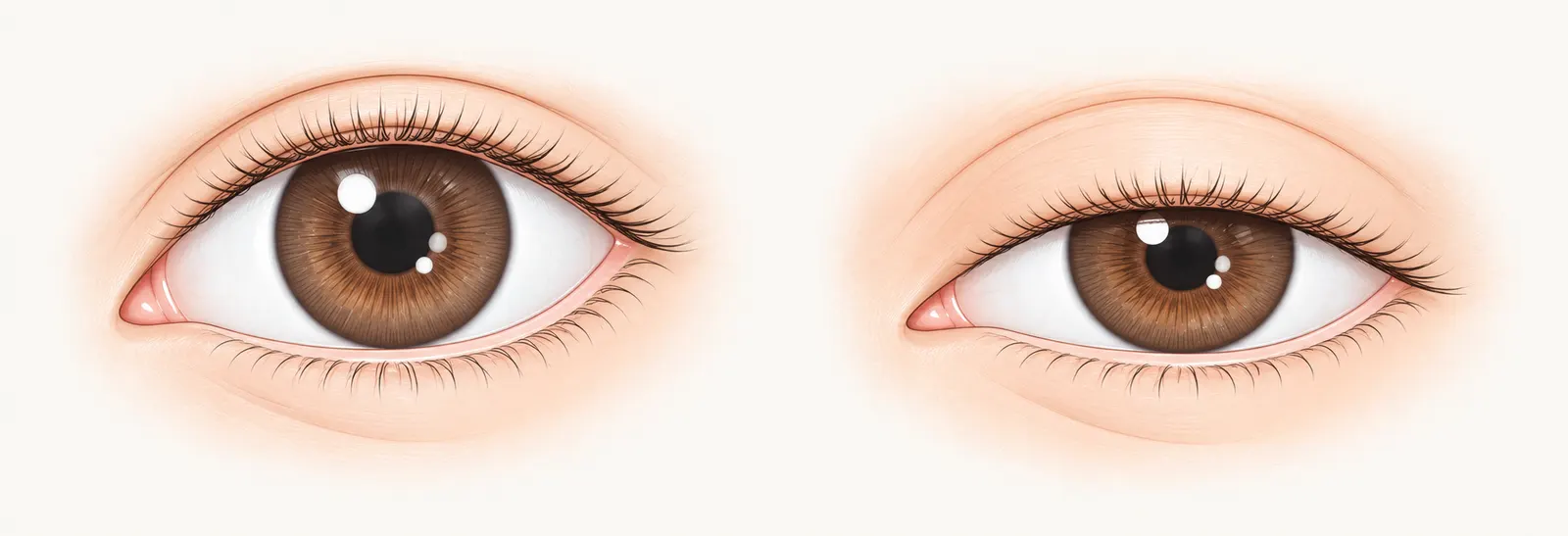
When ptosis correction may be needed
- Weak eye opening lets the upper eyelid cover part of the pupil
- Your eyes look sleepy, or you raise your forehead to open your eyes and develop forehead wrinkles
- Your eyes differ in size
- You are having revision surgery for "sausage eyes" (an overly thick, high double eyelid line)
- You have sunken upper eyelids or multiple eyelid creases
Whether you need ptosis correction is decided at consultation after checking the strength of the eye-opening muscle.
What is eyelid ptosis?
Eyelid ptosis is a condition in which the upper eyelid covers part of the pupil because the eye-opening muscle (levator) is weak or its connection to the eyelid has loosened. It can be present from birth or develop later due to aging, long-term contact lens wear, or a habit of rubbing the eyes. The eyes often look sleepy, or the forehead is used to open the eyes, causing forehead wrinkles. Depending on the degree, it is corrected with ptosis surgery.
How common is eyelid ptosis?
A study of 20,941 Korean adults aged 40 and older from the Korea National Health and Nutrition Examination Survey found that the prevalence of age-related ptosis was 13.5%, rising with age from 5.4% in people in their 40s to 32.8% in those aged 70 and older (Kim et al., 2017). Ptosis is not only a result of aging. A study of 8,218 Korean children and adolescents aged 3–18 from the same survey (2008–2012) reported drooping upper eyelids in 8.0% (Cho et al., 2020), and a 40-year population-based study in the United States found simple congenital ptosis present from birth in about 1 in 842 births (Griepentrog et al., 2011).
Can I have ptosis even if my eyelid height looks normal?
Even if your eyelid height is within the normal range, you may have hidden ptosis if you are using your forehead to keep your eyes open. A study reported that this kind of subclinical ptosis is common in Asian patients having cosmetic upper eyelid surgery, and that correcting the ptosis component as well is important for predictable results (Wong et al., 2024).
Do all sleepy-looking eyes need ptosis correction?
Not all sleepy-looking eyes are caused by ptosis. In pseudoptosis, drooping skin covers the eyelid and makes the eyes look smaller, and in other cases the eyebrows themselves have descended and make the eyes look heavy, so at consultation we first identify the cause.
| Surgery considered | |
|---|---|
| Weak eye opening (eyelid ptosis) | Ptosis correction |
| Drooping skin covering the eyelid (pseudoptosis) | Double eyelid surgery, upper blepharoplasty or sub-brow lift |
| Drooping eyebrows | Endoscopic brow lift |
| Both skin drooping and ptosis | Double eyelid surgery or upper blepharoplasty + ptosis correction |
In middle age, skin drooping and ptosis often occur together, so both are checked.
More about Double Eyelid Surgery →More about Upper Blepharoplasty →More about Sub-Brow Lift →
How is ptosis correction different from double eyelid surgery?
The eyelid has a front layer and a back layer. The front layer (anterior lamella) is the skin, and the back layer (posterior lamella) is the eye-opening muscle and the inner lining (conjunctiva). If either one descends, it covers the pupil. Double eyelid surgery lifts the skin of the front layer, while ptosis correction raises the back layer. If your eye-opening strength is normal, double eyelid surgery alone is often enough.
| Front layer (anterior lamella) | Back layer (posterior lamella) | |
|---|---|---|
| Tissue | Skin | Eye-opening muscle and conjunctiva |
| Surgery that lifts it | Double eyelid surgery | Ptosis correction |
Making a large double eyelid line without checking eye-opening strength can make the eyes look even sleepier or create an unnatural, "sausage-like" look.
Compare ptosis correction and double eyelid surgery in detail →More about Double Eyelid Surgery →
How is ptosis correction for men different?
Ptosis correction for men focuses on improving a sleepy or tired look, and the amount of correction is adjusted so the eyes do not look overly large. Men often have thicker eyelids and a shorter distance between the eyebrow and eye, so overcorrection can make the face look harsh. Whether to do ptosis correction alone without a double eyelid or to add a low double eyelid line is decided at consultation based on your facial impression.
What else is checked for ptosis correction in middle age?
For middle-aged patients who have long used the forehead to open their eyes, upper blepharoplasty that only removes drooping skin may not relieve the difficulty in opening the eyes, so the eyes may still look sleepy or droop again. In middle age, skin drooping and ptosis often occur together, so we check eye-opening strength before surgery and, if needed, perform ptosis correction through the same incision.
In age-related ptosis, the eye-opening muscle may still be strong, but the ligament-like tissue connecting the muscle to the eyelid (the levator aponeurosis) stretches, making it hard to open the eyes fully. In this case, incisional ptosis correction re-secures and strengthens the stretched aponeurosis.
Middle-Aged Eye Surgery at a glance →More about Upper Blepharoplasty →
Can ptosis correction even out uneven eye size?
Whether uneven eyes can be corrected depends on the cause. Unevenness caused by different line heights or different amounts of skin drooping often improves with double eyelid surgery. If one eye opens more weakly, ptosis correction is needed as well, and asymmetry from differences in eyebrow height, bone structure or skin thickness may be difficult to fully match with surgery.
Why are both eyes checked when only one droops? (Hering's law)
The muscles that raise both eyelids receive equal nerve signals, which is known as Hering's law. So when one eyelid droops a lot, the signal to raise it also reaches the other side, and the other eye may appear more open than it really is. In this case, correcting only the drooping side can let the other eyelid come down and reveal drooping that had been masked; the literature reports this in about 10–20% of patients with one-sided ptosis (Zoumalan & Lisman, 2010; Chen et al., 2016).
Can this be predicted before surgery?
Before surgery, we lift the drooping eyelid by hand to see whether the height of the other eyelid changes. However, this test often cannot predict changes on the other side after surgery. One study also found that pre-operative test results did not match well with post-operative changes on the other side (Erb et al., 2004). So when ptosis is markedly uneven, we explain before surgery that the other eyelid may come down after surgery regardless of the test results, and that additional correction may then be needed.
How do non-incisional and incisional ptosis correction differ?
Non-incisional ptosis correction tightens the eye-opening muscle with sutures placed through tiny openings without cutting the skin, while incisional ptosis correction opens the double eyelid line so the muscle can be seen and corrected directly.
The non-incisional method involves less swelling and an easier recovery and suits mild drooping. The incisional method is mainly chosen for larger corrections, uneven eye size, and revision surgery.
What should I check at a ptosis correction consultation?
The key to ptosis correction is how much to correct eye-opening strength, so check whether the following are explained at your consultation.
- Whether your eye-opening strength is measured directly and the results are explained
- Whether the double eyelid line and eye-opening strength are planned separately
- Whether the habit of using the forehead to open the eyes and left–right differences are checked
- Whether the reason for recommending non-incisional or incisional surgery is explained
- Whether the possibility of over- or undercorrection and how it would be revised are explained in advance
- Whether the doctor you consult with performs the surgery and follows up personally
Ptosis correction swelling and recovery time
Swelling and recovery after ptosis correction are similar to double eyelid surgery, and combining the two does not usually make swelling much worse or recovery much longer. Noticeable swelling usually settles considerably within 1–2 weeks for non-incisional and 2–4 weeks for incisional surgery.
2–3 days after surgery
- Swelling and bruising are at their peak
First 3–5 days
- Sleep with your head elevated
- Cold compresses for the first 7 days
After 3 days
- Makeup is allowed on areas without wounds
Around 1 week
- Incisional: stitches removed, face washing from the next day
After 4 weeks
- Makeup on the sutured area and contact lenses are allowed
- Alcohol and smoking can be resumed, no earlier than 4 weeks after surgery
Ptosis correction side effects and the amount of correction
Overcorrecting eyes that already have normal eye-opening strength can leave the eyes unable to close fully or give a wide-eyed, harsh look. After ptosis correction, incomplete eye closure, overcorrection, undercorrection, left–right asymmetry, or loss of correction can occur. Eye-opening muscle strength differs from person to person and between sides, so the amount of correction is adjusted during surgery while checking how far the eyes open.
If overcorrection or asymmetry persists after the swelling has gone down, revision may be considered. Revision is usually done 6 months or more after surgery, though in some cases corrective surgery is done earlier.
Ptosis Correction (Droopy Eyelid Surgery) FAQ
Can I have ptosis correction without a double eyelid?
Ptosis correction without a double eyelid is possible and is often called monolid ptosis correction. Strictly speaking, a thin hidden crease that is hard to see when the eyes are open is created at the same time. It is considered when you want to keep a monolid look while showing more of the pupils.
Do I need ptosis correction along with double eyelid surgery?
Ptosis correction is not needed for every double eyelid surgery; it is considered when weak eye opening leaves the pupils partly covered, the eyes look sleepy, or eye size is asymmetric. Whether you need ptosis correction is decided at consultation after checking the strength of the eye-opening muscle.
Can upper blepharoplasty and ptosis correction be done together?
Upper blepharoplasty and ptosis correction can be done together. In middle age, skin drooping is often accompanied by ptosis from weakened eye-opening muscles, so removing only skin may leave the eyes still looking sleepy. We check eye-opening strength before surgery and, if needed, perform ptosis correction through the same incision.
Can canthoplasty be combined with double eyelid surgery or ptosis correction?
Canthoplasty can be combined with double eyelid surgery or ptosis correction. When the epicanthal fold covers the inner end of the double eyelid line, adding epicanthoplasty (inner corner) or upper epicanthoplasty can help the line flow naturally, and if eye opening is weak, adding ptosis correction can also improve the vertical height of the eyes. When several procedures are combined, the amount of each correction is set by looking at the overall proportions of the eyes.
What are the recovery time and swelling like after ptosis correction?
Swelling and recovery time after ptosis correction are similar to double eyelid surgery. Adding ptosis correction does not usually make swelling much worse or recovery much longer, and noticeable swelling usually settles considerably within 1–2 weeks for non-incisional and 2–4 weeks for incisional surgery.
When can ptosis correction revision be done?
Ptosis correction revision is usually done 6 months or more after the previous surgery, once the swelling has gone down and the tissue has settled. However, when needed, such as when overcorrection keeps the eyes from closing well or there is a clear left–right difference, corrective surgery may be done earlier. The timing and method are decided after examining your eyes.
How is the cost of ptosis correction determined?
The cost of ptosis correction depends on the method (non-incisional or incisional), whether combined procedures such as double eyelid surgery, canthoplasty or upper blepharoplasty are done, whether it is a revision, and whether left–right asymmetry is corrected. The extent of correction can differ with eye-opening strength and eyelid condition, so the exact cost is given after consultation.
Your doctor

Dr. Dahan Kim
Board-Certified Plastic Surgeon Medical Director, Steady Plastic Surgery
Steady Plastic Surgery is an eye-focused plastic surgery clinic in Gangnam (Sinnonhyeon), Seoul. Board-certified plastic surgeon Dr. Dahan Kim personally sees every patient from consultation to surgery and follow-up, focusing on double eyelid surgery, double eyelid revision, under-eye fat repositioning, lower blepharoplasty and middle-aged eye surgery.
- M.D. and master's degree, CHA University School of Medicine
- Plastic surgeon, CHA Bundang Medical Center
- Member, Korean Society of Plastic and Reconstructive Surgeons · Korean Society for Aesthetic Plastic Surgery · Korean Association of Plastic Surgeons
Have questions?
References
- Kim MH, Cho J, Zhao D, Woo KI, Kim YD, Kim S, Yang SW. Prevalence and associated factors of blepharoptosis in Korean adult population: The Korea National Health and Nutrition Examination Survey 2008-2011. Eye (Lond). 2017;31(6):940-946. doi:10.1038/eye.2017.43 PMID 28338663
- Wong CH, Hsieh MKH, Mendelson B. Subclinical Upper Eyelid Ptosis in Asian Patients: The Role of Levator Advancement in Optimizing Outcomes in "Cosmetic" Upper Blepharoplasty. Aesthetic Plast Surg. 2024;48(2):141-151. doi:10.1007/s00266-023-03697-1 PMID 37821553
- Cho BJ, Choi YJ, Shin MC, Yang SW, Lee MJ. Prevalence and risk factors of childhood blepharoptosis in Koreans: The Korea National Health and Nutrition Examination Survey 2008-2012. Eye (Lond). 2020;34(9):1585-1591. doi:10.1038/s41433-019-0697-3 PMID 31772383
- Griepentrog GJ, Diehl NN, Mohney BG. Incidence and demographics of childhood ptosis. Ophthalmology. 2011;118(6):1180-1183. doi:10.1016/j.ophtha.2010.10.026 PMID 21496927
- Zoumalan CI, Lisman RD. Evaluation and management of unilateral ptosis and avoiding contralateral ptosis. Aesthet Surg J. 2010;30(3):320-328. doi:10.1177/1090820X10374108 PMID 20601555
- Chen AD, Lai YW, Lai HT, Huang SH, Lee SS, Chang KP, Lai CS. The impact of Hering's law in blepharoptosis: literature review. Ann Plast Surg. 2016;76 Suppl 1:S96-S100. doi:10.1097/SAP.0000000000000689 PMID 26808763
- Erb MH, Kersten RC, Yip CC, Hudak D, Kulwin DR, McCulley TJ. Effect of unilateral blepharoptosis repair on contralateral eyelid position. Ophthal Plast Reconstr Surg. 2004;20(6):418-422. doi:10.1097/01.iop.0000143714.10858.d4 PMID 15599239
- 박대환, 백봉수, Nahai F. 안성형외과학. 제3판. 군자출판사; 2009. ISBN 978-89-6278-139-7. [in Korean]
- Cho I. The Art of Blepharoplasty. Koonja Publishing; 2017. ISBN 979-11-5955-234-2.
- 대한미용성형외과학회. 미용성형외과학 2. 제2판. 군자출판사; 2023. ISBN 979-11-7068-001-7. [in Korean]