Under-Eye Fat Repositioning
Eye bags, under-eye hollows, dark circles: we identify the cause first

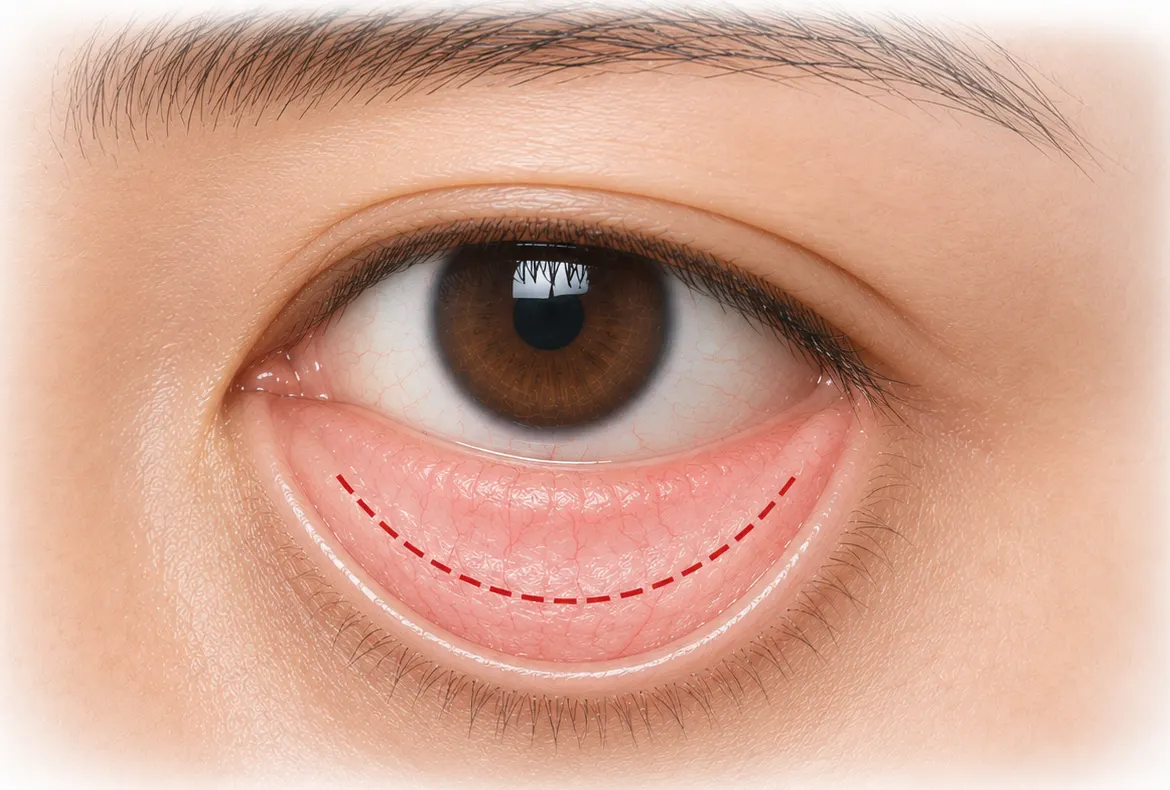
Under-eye fat repositioning is a transconjunctival procedure (through the inner eyelid) that moves bulging under-eye fat into the hollow tear trough and spreads it out, rather than removing it.
It is considered when puffy under-eye bags appear together with a shadow (hollow) below them. If skin laxity and wrinkles are prominent, lower blepharoplasty is also evaluated.
Under-Eye Fat Repositioning at a glance
- Suitable for
- Bulging under-eye fat + under-eye hollow (shadow)
- Approach
- Transconjunctival incision (inside the eyelid)
- Surgery time
- About 1 hour
- Anesthesia
- IV sedation
- Stitch removal
- Yes / No (depends on method)
- Clinic visits
- 1–2
- Swelling & bruising
- 1–2 weeks
- Return to daily life
- Within a few days without stitches / 1 week with stitches
This may vary depending on each patient's condition and the surgical method.
Quick answer
How is under-eye fat repositioning different from lower blepharoplasty, and what is recovery like?
Under-eye fat repositioning moves fat through the inner lining of the eyelid (the conjunctiva), so there is no incision line on the outer skin. Lower blepharoplasty involves an incision just below the lash line to also address loose skin and wrinkles, and it is considered when skin laxity is pronounced. Swelling and bruising after under-eye fat repositioning usually last about 1–2 weeks. Recovery speed and results vary by individual.
What is under-eye fat repositioning?
Under-eye fat repositioning is a procedure that reaches the bulging under-eye fat through the conjunctiva on the inside of the eyelid and moves it into the hollow tear trough. Because the fat is repositioned through the inner eyelid, there is no incision line on the outer skin.
Who is a good candidate for under-eye fat repositioning?
- Bulging under-eye fat (eye bags) makes you look tired and worn out
- A deep tear trough makes your eyes look sunken and hollow
- Shadow-type dark circles make your face look dark and dull
Under-eye fat repositioning vs. fat removal vs. lower blepharoplasty vs. under-eye filler
| Under-Eye Fat Repositioning | Under-Eye Fat Removal | Lower Blepharoplasty | Under-Eye Filler | |
|---|---|---|---|---|
| Suitable for | Bulging fat + hollowness | Mainly bulging fat | Fat + loose skin and wrinkles | Hollow tear trough |
| Method | Fat is spread out and repositioned | Fat is removed | Fat contouring + skin excision | Filled by injection |
| Incision | Yes (conjunctiva) | Yes (conjunctiva) | Yes (skin below the lash line) | None |
Learn more about lower blepharoplasty →Detailed comparison: under-eye fat repositioning vs. lower blepharoplasty →Detailed comparison: under-eye fat repositioning vs. fat removal →
How under-eye fat repositioning is performed
- 1
Conjunctival incision
An incision is made through the conjunctiva on the inside of the eyelid.
- 2
Fat repositioning
The bulging fat is spread out and moved evenly into the hollow area.
- 3
Septum fixation
The loosened orbital septum is secured to reduce the chance of the fat bulging out again.
- 4
Closure
The incision is closed and left–right balance is checked.
Six things we assess before surgery
How much the under-eye fat bulges
Based on the degree of bulging, we decide whether to remove the fat or reposition it into the hollow area.
How deep the tear trough is
Depending on how deep the hollow is, we judge whether fat repositioning alone is enough or whether a fat graft should be added.
How much the skin sags
If skin laxity is pronounced, lower blepharoplasty, which also addresses the loose skin, is considered.
Whether the shadow comes from pigment or blood vessels
Shadows caused by pigmentation or visible blood vessels may not change much with surgery, so we estimate in advance what change surgery can realistically offer before deciding whether to proceed.
Whether the eyes are prominent or deep-set
Depending on how prominent or deep-set the eyes are, we plan combined procedures such as a fat graft or orbicularis oculi muscle suspension.
How much fat there is in the front of the cheek
Depending on the amount of fat in the front cheek, we consider whether to combine a midface lift or fat graft.
Swelling and recovery after under-eye fat repositioning
Based on our post-operative care instructions.
Day 2 after surgery
- Compression tape removed
- Rest for 2–3 days
Days 2–3
- Swelling and bruising peak
Days 3–5
- Sleep with your head elevated
After day 3
- Without stitches, washing your face with water is OK (with stitches, from the day after removal)
- Makeup on areas without incisions is OK
Around 1 week
- Stitches removed, if any
- Cold compresses throughout the first 7 days
- Eye drops throughout the first week
- Foam cleanser is OK
After 4 weeks
- Contact lenses are OK
- Alcohol, smoking, strenuous exercise and saunas can be resumed
Temporary tearing, eye discharge, or blurred vision may occur. Recovery time varies by individual.
Side effects and precautions
What side effects can occur after under-eye fat repositioning?
After under-eye fat repositioning, besides temporary swelling, bruising, and a foreign-body sensation, rare side effects may include asymmetry, fat clumping (nodules), remaining hollowness or puffiness, ectropion (the lower eyelid turning outward), and diplopia (double vision). The likelihood depends on your under-eye condition and the surgical method, so a thorough consultation before surgery and follow-up checks afterward are important.
My under-eye area feels firm or lumpy after under-eye fat repositioning. Is this normal?
Feeling firmness or slight lumpiness under the eyes after under-eye fat repositioning is common during recovery. This temporary firmness occurs as the repositioned fat attaches to the surrounding tissue, and it usually softens over 3–6 months. If the symptoms are bothersome, or if there is pain or redness, it is best to visit the clinic to have it checked.
Can all dark circles be improved with surgery?
Not all dark circles can be improved with surgery, because treatment depends on the cause. Fat-type dark circles, where bulging under-eye fat casts a shadow, often improve with under-eye fat repositioning, while pigment-type dark circles caused by skin pigmentation or vascular-type dark circles where blood vessels show through thin skin call for laser or skin treatments. Many people have a mix of causes, so we identify the cause first during the consultation.
Can wrinkles appear under the eyes after under-eye fat repositioning?
Rather than new wrinkles forming after under-eye fat repositioning, existing fine lines or reduced skin elasticity may become more noticeable once the bulge is gone. Skin that was stretched tight by the bulging fat becomes looser and more visible, and if there is a lot of skin laxity, lower blepharoplasty is considered.
Is revision surgery ever needed after under-eye fat repositioning?
Revision after under-eye fat repositioning is uncommon, but it may be considered if too little fat was moved and puffiness remains, or if too much was moved and a hollow forms. Revision is usually done after 6 months, once the tissue has stabilized. To reduce these cases, it is important to plan surgery taking into account the amount of fat and how hollow the upper cheek is.
Under-Eye Fat Repositioning FAQ
Can I have under-eye fat repositioning if my under-eyes are already hollow?
Under-eye fat repositioning can be done even if your under-eye area is hollow, but if there is little under-eye fat or the hollowness is severe, a different procedure may be needed. Depending on the border where the under-eye area meets the front of the cheek, the size of the cheekbones, and the amount of fat in the cheekbone area, we plan fat repositioning, septal reinforcement, a midface lift, or a fat graft. It is best to identify the cause first through a detailed consultation with a board-certified plastic surgeon.
How can I tell if my dark circles are caused by fat?
If the area under your eyes bulges, a shadow forms below it, and the shadow fades when you gently pull the under-eye skin, it is likely a fat-type dark circle. People who are often told they look tired even when they are not frequently have the fat type as well. Pigment-type dark circles often keep their brown or bluish color even when the skin is pulled, and we recommend an in-person consultation for an accurate diagnosis.
How long do swelling and bruising last after under-eye fat repositioning?
Swelling and bruising after under-eye fat repositioning usually go down noticeably within 1–2 weeks. They are worst on days 2–3 after surgery and gradually decrease after that. Early on, you may have more tearing or eye discharge, or temporarily blurred vision. Cold compresses for 7 days, sleeping with your head elevated for 3–5 days, resting for 2–3 days, and avoiding alcohol and smoking for 4 weeks can help recovery, and results vary by individual.
Does under-eye fat repositioning leave a scar?
Under-eye fat repositioning is performed with a transconjunctival approach through the inner side of the lower eyelid, so there is no incision on the skin. The conjunctival incision is closed with dissolvable sutures that do not need to be removed; only with the external fixation method are the fixation sutures that exit through the under-eye skin removed at around 7 days. However, if the skin sags enough that it also needs to be addressed, lower blepharoplasty is considered.
How is under-eye fat repositioning different for men?
Under-eye fat repositioning for men focuses on improving a tired-looking appearance, and the surgical method itself is the same as for women. Men often have thicker skin and more under-eye fat, so the amount of fat is carefully adjusted, and the goal is a natural under-eye line without making the aegyo-sal (the small fullness under the lower lash line) overly prominent.
When can I drink, smoke, or exercise after under-eye fat repositioning?
After under-eye fat repositioning, it is best to avoid alcohol and smoking for at least 4 weeks. Alcohol can make swelling and bruising last longer, and smoking reduces blood circulation, which can slow wound healing and increase the risk of inflammation. Swimming, saunas, and strenuous exercise should also be avoided for 4 weeks, while light walks are fine from the day after surgery.
How is the cost of under-eye fat repositioning determined?
The cost of under-eye fat repositioning depends on how much the fat bulges, the extent of correction, and whether a fat graft is combined. Even for the same procedure, the scope of surgery can differ depending on your under-eye condition, so an exact cost can be provided after a consultation.
Your doctor

Dr. Dahan Kim
Board-Certified Plastic Surgeon Medical Director, Steady Plastic Surgery
Steady Plastic Surgery is an eye-focused plastic surgery clinic in Gangnam (Sinnonhyeon), Seoul. Board-certified plastic surgeon Dr. Dahan Kim personally sees every patient from consultation to surgery and follow-up, focusing on double eyelid surgery, double eyelid revision, under-eye fat repositioning, lower blepharoplasty and middle-aged eye surgery.
- M.D. and master's degree, CHA University School of Medicine
- Plastic surgeon, CHA Bundang Medical Center
- Member, Korean Society of Plastic and Reconstructive Surgeons · Korean Society for Aesthetic Plastic Surgery · Korean Association of Plastic Surgeons
Have questions?
References
- Hamra ST. Arcus marginalis release and orbital fat preservation in midface rejuvenation. Plast Reconstr Surg. 1995;96(2):354-362. doi:10.1097/00006534-199508000-00014 PMID 7624408
- Goldberg RA. Transconjunctival orbital fat repositioning: transposition of orbital fat pedicles into a subperiosteal pocket. Plast Reconstr Surg. 2000;105(2):743-748. doi:10.1097/00006534-200002000-00044 PMID 10697189
- Hashem AM, Couto RA, Waltzman JT, Drake RL, Zins JE. Evidence-Based Medicine: A Graded Approach to Lower Lid Blepharoplasty. Plast Reconstr Surg. 2017;139(1):139e-150e. doi:10.1097/PRS.0000000000002849 PMID 28027251
- Mojallal A, Cotofana S. Anatomy of lower eyelid and eyelid-cheek junction. Ann Chir Plast Esthet. 2017;62(5):365-374. doi:10.1016/j.anplas.2017.09.007 PMID 29033216
- Buchanan DR, Wulc AE. Contemporary thoughts on lower eyelid/midface aging. Clin Plast Surg. 2015;42(1):1-15. doi:10.1016/j.cps.2014.09.003 PMID 25440737
- Nahai F, Niazi F, Nahai F, et al. An Overview of Surgical Approaches for Lower Eyelid Blepharoplasty. Aesthet Surg J. 2023;43(12):1429-1440. doi:10.1093/asj/sjad245 PMID 37531619
- Etman AG, Badawy MS, Setta HS, Magdy A, El-Badawy A. Evaluation of Fat Excision versus Sparing in Lower Blepharoplasty Using Orbital Gray Scale Analysis. Plast Reconstr Surg Glob Open. 2022;10(9):e4530. doi:10.1097/GOX.0000000000004530 PMID 36203736
- 박대환, 백봉수, Nahai F. 안성형외과학. 제3판. 군자출판사; 2009. ISBN 978-89-6278-139-7. [in Korean]
- Cho I. The Art of Blepharoplasty. Koonja Publishing; 2017. ISBN 979-11-5955-234-2.
- 대한미용성형외과학회. 미용성형외과학 2. 제2판. 군자출판사; 2023. ISBN 979-11-7068-001-7. [in Korean]