Thread Lift (Face Thread Lift)
Sagging cheeks, jawline, and smile lines

A thread lift (face thread lift) is a procedure in which absorbable threads with tiny barbs (cogs) are placed beneath the skin to hook, lift, and hold sagging tissue.
It may be considered when you want to improve a sagging jawline, cheeks, or smile-line area without incisions.
Thread Lift at a glance
- Procedure time
- About 30 minutes
- Anesthesia
- Local anesthesia or IV sedation
- Stitch removal
- Not required
- Healing tape
- Removed after 3 days
- Swelling & bruising
- 1 week
- Return to daily life
- Right away
These may vary depending on the type and number of threads and the treatment area.
Quick answer
When is a thread lift recommended?
A thread lift may be considered when you want to improve a sagging jawline, cheeks, or smile-line area without incisions. When sagging is mild, a thread lift often brings improvement; the procedure takes about 30 minutes, and you can return to daily life right away.
What is a thread lift (face thread lift)?
A thread lift is a procedure in which absorbable threads with tiny barbs (cogs) are placed beneath the skin to hook, lift, and hold sagging tissue. It is done without incisions; you can feel the lift and see the change right after the procedure, and the result looks more natural after 1–2 months as the swelling subsides.
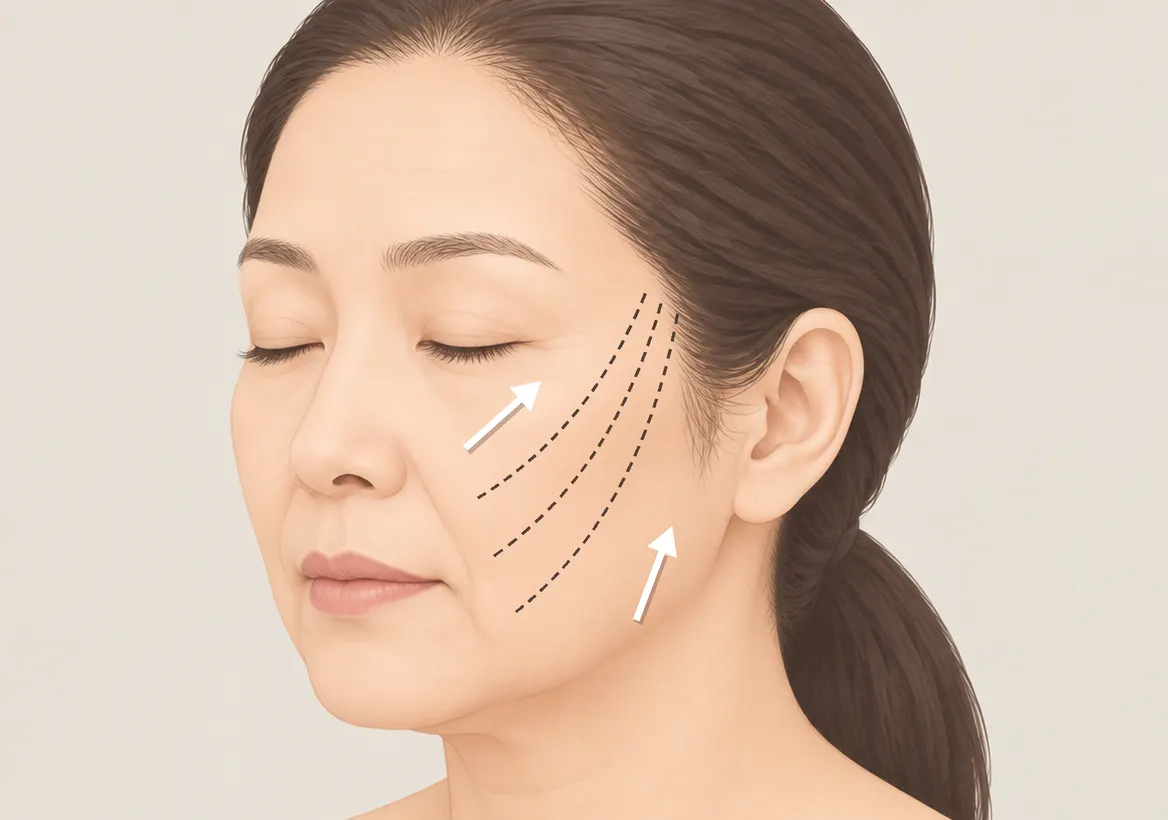
In a study of 39 Korean patients, satisfaction after a thread lift was 89.7% (Kang et al., 2017).
When a thread lift may be needed
- Your facial contours are not what they used to be and you would like a lift
- Sagging cheeks make the smile-line area look deeper
- A sagging jawline and double chin have blurred your facial contours
- You want to improve sagging in a short time without incisions
What kind of threads are used in a thread lift?
A thread lift uses absorbable threads with tiny barbs (cogs) on the surface. The barbs catch the tissue beneath the skin to lift and hold sagging tissue, and the threads are gradually absorbed by the body over time. How long results last depends on the type and number of threads and your skin condition, and the procedure may be repeated around the time the previous threads are absorbed.
In an animal study comparing absorbable threads (PDO and PCL), collagen in the surrounding tissue increased with both materials over the 12 weeks after the procedure (Ha et al., 2022).
How a thread lift is performed
- 1
Design
The direction and number of threads are planned based on where and how much the face has sagged.
- 2
Anesthesia
The procedure is performed under local anesthesia or IV sedation.
- 3
Thread placement & lifting
Barbed threads are placed beneath the skin to lift and hold the sagging tissue upward.
- 4
Finishing
Healing tape is applied to the treated area, and the procedure is completed in about 30 minutes.
What we check during a thread lift consultation
- Where and how much the face has sagged (cheeks, jawline, smile-line area)
- Skin thickness and elasticity
- Amount of facial fat and volume
- Timing of any previous thread lift and remaining threads
- Type and number of threads needed
Thread lift recovery and swelling
After a thread lift you can return to daily life right away, and the result looks more natural after 1–2 months as the swelling subsides. Cold compresses for 7 days and sleeping with your head elevated for 3–5 days can help reduce swelling.
Next day
- Face washing and a light shower allowed (do not rub the treated area hard)
- Makeup allowed except on the insertion points
- Light strolls and walking allowed
3 days
- Healing tape removed
First 3–5 days
- Raise your pillow to keep your head above your heart
- Sleep on your back rather than on your side
First 7 days
- Cold compresses
First 2 weeks
- Do not rub or press hard on the treated area
- No energy-based lifting such as radiofrequency or ultrasound (allowed after 2 weeks)
First 4 weeks
- Avoid opening your mouth wide, exaggerated facial expressions, and facial or deep massage
- Avoid smoking, alcohol, strenuous exercise, swimming, baths, saunas, and heated spas
Thread lift side effects and precautions
What are the possible side effects of a thread lift?
After a thread lift, the face may temporarily feel tight or tingly, or your expressions may feel slightly stiff; this improves over time. Dimpling, where the skin over the threads looks indented, usually improves within 2 weeks to 1 month, and rarely there may be left–right asymmetry, a visible or protruding thread, or inflammation. If you notice a bad smell in your mouth or yellow pus, contact the clinic.
Contact the clinic if you have these symptoms
Contact the clinic if you have severe pain not controlled by pain medication, continuous bleeding, a feeling of heat, significant swelling on one side only, or a bad smell or yellow pus in your mouth.
Thread Lift FAQ
How long do thread lift results last?
With a thread lift, you can feel the lift and see the change right after the procedure, and the result looks more natural after 1–2 months as the swelling subsides. How long results last depends on the type and number of threads and your skin condition, and in many cases they last about 1–2 years.
How often can I have a thread lift?
A thread lift is often repeated at 1–2-year intervals, around the time the previous threads are absorbed and the effect fades. Repeating it at very short intervals can leave overlapping threads beneath the skin that may feel uneven, so we plan the next procedure after checking the timing and condition of the previous one.
When can I have radiofrequency or ultrasound lifting after a thread lift?
After a thread lift, energy-based lifting such as radiofrequency or ultrasound is best done after 2 weeks, once the threads have settled. We proceed after confirming that swelling and tightness in the treated area have subsided.
How is a thread lift different from a facelift?
A thread lift lifts sagging tissue with threads without incisions, while a facelift is surgery that involves skin incisions, releases the fascia layer to reposition sagging tissue, and removes excess skin. When sagging is mild, a thread lift often brings improvement, and when there is a lot of loose skin that needs to be removed, a facelift is considered. The approach is decided after checking the degree of sagging during the consultation.
How is the cost of a thread lift determined?
The cost of a thread lift depends on the type and number of threads used and the treatment area. Because the number of threads needed varies with the degree of sagging, an exact cost can be given after consultation.
Your doctor

Dr. Dahan Kim
Board-Certified Plastic Surgeon Medical Director, Steady Plastic Surgery
Steady Plastic Surgery is an eye-focused plastic surgery clinic in Gangnam (Sinnonhyeon), Seoul. Board-certified plastic surgeon Dr. Dahan Kim personally sees every patient from consultation to surgery and follow-up, focusing on double eyelid surgery, double eyelid revision, under-eye fat repositioning, lower blepharoplasty and middle-aged eye surgery.
- M.D. and master's degree, CHA University School of Medicine
- Plastic surgeon, CHA Bundang Medical Center
- Member, Korean Society of Plastic and Reconstructive Surgeons · Korean Society for Aesthetic Plastic Surgery · Korean Association of Plastic Surgeons
Have questions?
References
- Kang SH, et al. Vertical Lifting: A New Optimal Thread Lifting Technique for Asians. Dermatol Surg. 2017;43(10):1263-1270. doi:10.1097/DSS.0000000000001169 PMID 28430736
- Ha YI, et al. Histological and molecular biological analysis on the reaction of absorbable thread; Polydioxanone and polycaprolactone in rat model. J Cosmet Dermatol. 2022;21(7):2774-2782. doi:10.1111/jocd.14587 PMID 34847267