Canthoplasty (Inner Corner, Upper, Outer Corner & Lower Eyelid)
Only as much as your epicanthal fold and eye proportions call for

Canthoplasty is divided into epicanthoplasty (inner corner), upper epicanthoplasty, lateral canthoplasty (outer corner) and lower canthoplasty, depending on which part of the eye is opened. Two are often combined, such as inner and upper epicanthoplasty together, or lateral and lower canthoplasty together.
It is considered when the eyes still look short or narrow, horizontally or vertically, with double eyelid surgery alone. It is planned around the distance between the eyes, eye proportions and the look you want.
Canthoplasty at a glance
| Epicanthoplasty (inner corner) | Upper epicanthoplasty | Lateral canthoplasty (outer corner) | Lower canthoplasty | |
|---|---|---|---|---|
| Area | Inner corner of the eye (epicanthal fold) | Above the inner corner (epicanthal fold) | Outside the outer corner | Lower eyelid |
| What it addresses | Horizontal length, constricted inner corner | Constricted inner corner, start of the double eyelid line | Horizontal length, position of the outer corner | Vertical height of the eye |
| Stitch removal | 7 days | 7 days | 7–10 days | None |
| Surgery time | 30 minutes | 30 minutes | 30 minutes | 30 minutes |
Combining several areas, or adding double eyelid surgery or ptosis correction, takes longer, and this may vary by individual.
Quick answer
Which eyes need canthoplasty?
With canthoplasty, even a 1 mm difference can noticeably change your impression. So rather than choosing a type first, it is important to check whether your eyes need canthoplasty at all and how far they can be opened. More important than removing the epicanthal fold is opening only as much as needed to suit the distance between the eyes relative to the width of each eye.
What is canthoplasty?
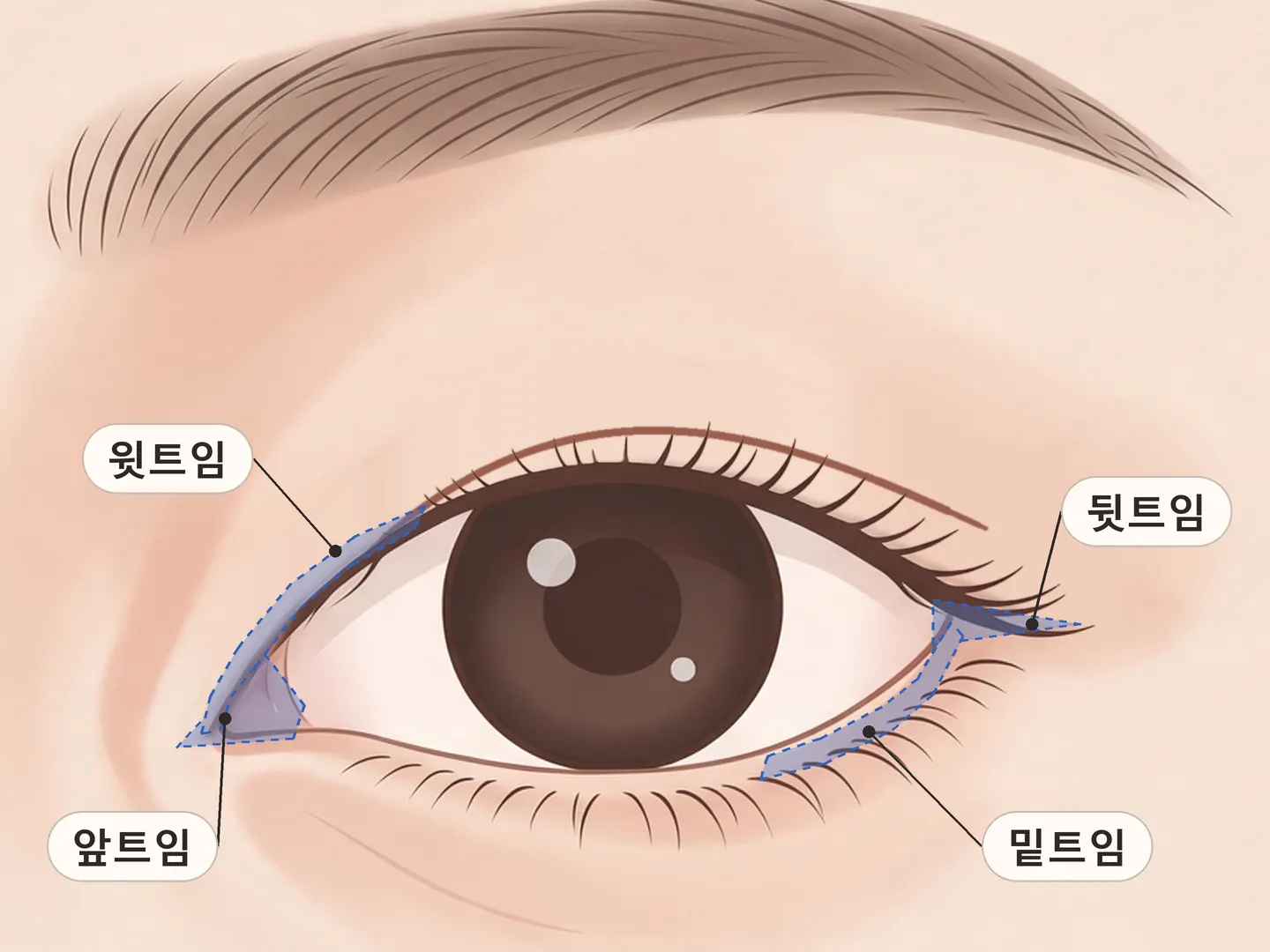
Canthoplasty is divided into 4 types depending on which part of the eye is opened: epicanthoplasty (inner corner), upper epicanthoplasty, lateral canthoplasty (outer corner) and lower canthoplasty.
Epicanthoplasty (inner corner): opening the epicanthal fold
Epicanthoplasty releases the epicanthal fold covering the inner corner of the eye to reveal the hidden inner part and increase the horizontal length of the eye. It is considered when the epicanthal fold makes the eyes look constricted, or when a wide distance between the eyes makes them look far apart. Because the shape of the inner corner changes as the fold is removed, your impression may change as well. The deeper tissue that forms the epicanthal fold is released and the skin is repositioned to open the covered inner corner.
Upper epicanthoplasty: opening above the inner corner
Upper epicanthoplasty opens the skin above the inner corner of the eye to reduce the part that hides the start of the double eyelid line and the constricted look. It is considered when you want to soften the inner corner without greatly changing the distance between the eyes, or to let an in-out or semi-out double eyelid line start naturally. It is often combined with epicanthoplasty (inner corner).
Lateral canthoplasty (outer corner): opening outside the outer corner
Lateral canthoplasty opens the area outside the outer corner of the eye to move the position of the outer corner; it can lengthen the eye horizontally or raise or lower the outer corner. It is considered when the eye is short horizontally or when upturned outer corners give a sharp look.
Lower canthoplasty: widening the lower eyelid
Lower canthoplasty widens the opening of the lower eyelid by lowering its outer part, increasing the vertical height of the eye for a more open look. It is considered when the lower part of the pupil is largely covered or little of the outer white of the eye shows, and it is often combined with lateral canthoplasty.
When canthoplasty may help
- The epicanthal fold makes the eyes look constricted, or a wide distance between the eyes makes them look far apart (epicanthoplasty, inner corner)
- The epicanthal fold hides the start of the double eyelid line, so an in-out or semi-out line does not start naturally (upper epicanthoplasty)
- The eye is short horizontally, or upturned outer corners give a sharp look (lateral canthoplasty, outer corner)
- The lower part of the pupil is largely covered, or little of the outer white of the eye shows (lower canthoplasty)
Epicanthoplasty is not recommended for eyes that are already close together or have almost no epicanthal fold, as it may make the eyes look crowded toward the center or give a sharp look.
Does every epicanthal fold need epicanthoplasty?
The epicanthal fold is a fold of skin that covers the inner corner of the eye and is common in East Asian people. A large epicanthal fold can hide the inner part of the eye, making the eyes look small and constricted or far apart, and it can also hide the inner end of the double eyelid line. However, epicanthoplasty is not recommended for eyes that are close together or have almost no epicanthal fold, as it may make the eyes look crowded toward the center or give a sharp look.
Opening too much in the hope of bigger eyes can expose too much of the lacrimal lake or make the scar more noticeable. Even with revision, epicanthoplasty is difficult to fully reverse to the pre-operative state, so it is important to open only as much as needed.
Can the opening close up again after lateral or lower canthoplasty?
With lateral and lower canthoplasty, the space that can be opened is limited by the size of the bony orbit around the eye and the depth of the eyeball. Opening too far without regard to bone structure can reduce the effect or cause side effects. With lateral canthoplasty, part of the opened area may reattach during healing, reducing the effect compared with what was expected. This is because the outer corner can only be extended so far due to its bone and ligament structure.
Lateral canthoplasty is commonly performed in East Asian patients, but a Korean study reported that post-operative complications or unwanted results are not uncommon (Kim et al., 2016). For this reason, lateral canthoplasty is done by fixing the lateral canthal tendon to the periosteum (see "How canthoplasty is performed" below).
How does raising or lowering the outer corner differ from canthoplasty?
Raising or lowering the outer corner of the eye is not a separate surgery; it is done together with lateral canthoplasty when you also want to change the height of the outer corner. After the outer corner is opened with lateral canthoplasty, the lateral canthal tendon that supports the outer corner is fixed to the periosteum, and the height of the outer corner changes depending on where this tendon is fixed.
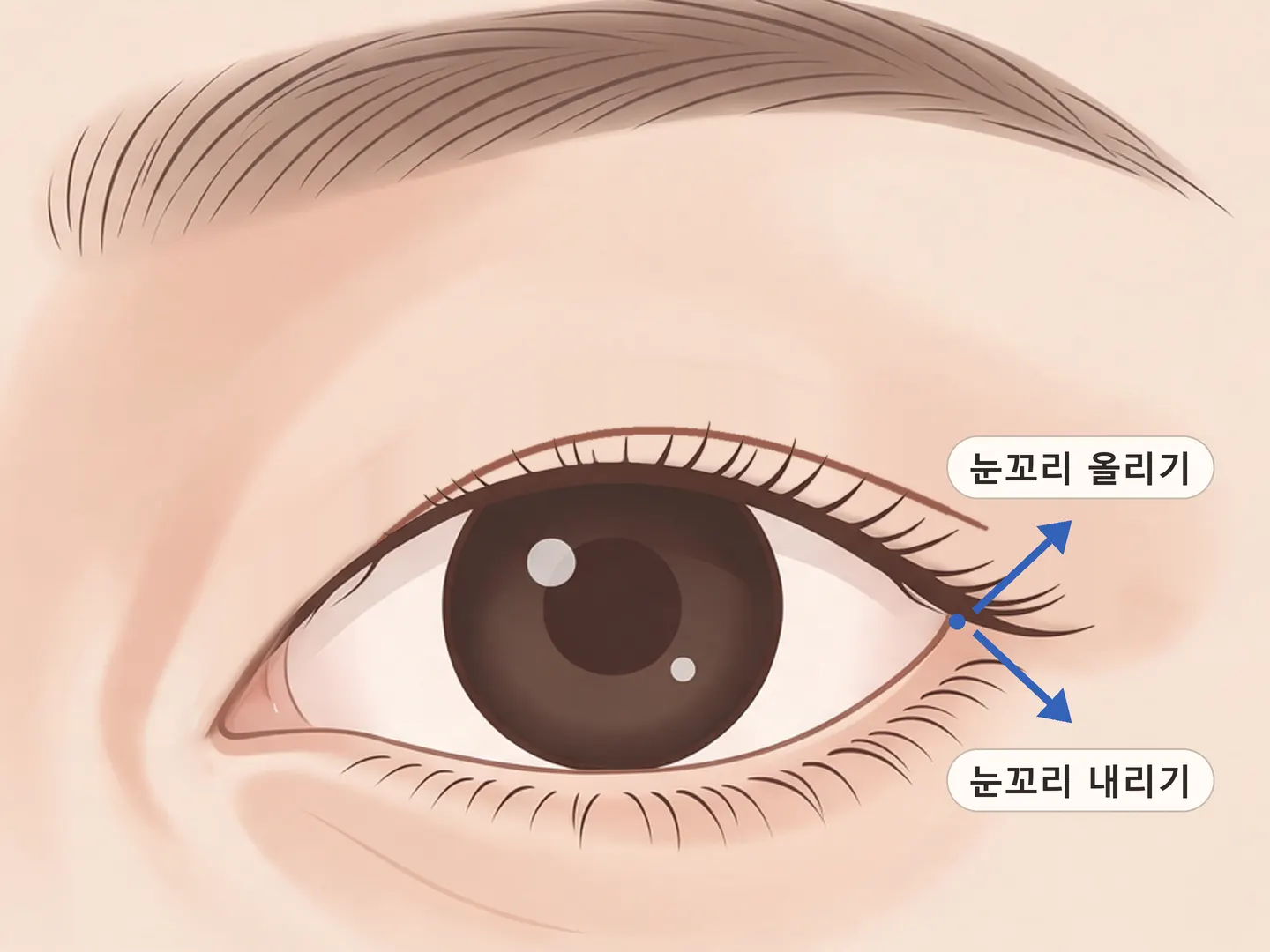
How much the outer corner can be raised or lowered is limited by the bone and ligament structure outside the outer corner, so the slant of the outer corner and its structure are checked at consultation.
How are epicanthoplasty scars minimized?
Canthoplasty involves a skin incision, so a scar remains, but because the incision is placed along the epicanthal fold or the border of the outer corner, it is often hard to see after healing. Early on there may be redness, which gradually fades over several months, and how much of a scar remains depends on skin type, constitution and aftercare.
In epicanthoplasty and upper epicanthoplasty, we minimize the amount of skin removed, carefully refine the underlying muscle to reduce tension, and close with fine sutures.
Can canthoplasty be combined with double eyelid surgery or ptosis correction?
Canthoplasty can be combined with double eyelid surgery or ptosis correction. When the epicanthal fold covers the inner end of the double eyelid line, adding epicanthoplasty (inner corner) or upper epicanthoplasty can help the line flow naturally, and if eye opening is weak, adding ptosis correction can also improve the vertical height of the eyes. When several procedures are combined, the amount of each correction is set by looking at the overall proportions of the eyes.
More about Double Eyelid Surgery →More about Ptosis Correction →
Reversing epicanthoplasty or lateral canthoplasty: why the first surgery matters more
Epicanthoplasty and lateral canthoplasty can be revised, but the goal is to naturally reduce areas that were opened too much rather than fully restore the pre-operative state. Epicanthoplasty revision uses surrounding skin to recreate an epicanthal fold and reduce overexposure of the inner corner, while lateral canthoplasty revision re-fixes a widened outer corner to the periosteum.
The extent of correction depends on existing scars and the amount of remaining skin, and revision is often more difficult than the first surgery. That is why, rather than seeking a dramatic change at the first surgery, it is important to open only as much as needed within the structure of your eyes.
How canthoplasty is performed
How is epicanthoplasty (inner corner) performed? (Skin redraping method)
At Steady Plastic Surgery, epicanthoplasty is mainly performed with the skin redraping method. The deeper tissue that forms the epicanthal fold is released, and the skin that covered the inner corner is spread out and repositioned; some skin is removed, but the amount can be reduced.
How is lateral canthoplasty (outer corner) performed? (Lateral canthal tendon fixation)
In lateral canthoplasty, rather than incising only the skin, we fix the lateral canthal tendon, which supports the outer corner, to the periosteum on the inner side of the orbital rim. This helps reduce reattachment after surgery and eversion (turning outward) of the outer corner.
What is checked at a canthoplasty consultation?
At consultation, we check the following together before deciding which areas to open and by how much.
- The distance between the eyes relative to the width of each eye
- The ratio between face width and the eyes
- The ratio between the white of the eye and the iris
- The size of the epicanthal fold and how much it hides the inner end of the double eyelid line
- Asymmetry of the overall facial skeleton
- The slant of the outer corner and the bone and ligament structure outside it
- How much the lower eyelid covers the pupil
- Eye-opening strength (whether ptosis correction is needed)
- The look you want and how much change you want
Canthoplasty recovery time
With canthoplasty alone, swelling and bruising tend to be mild. Daily activities are possible right after surgery, but many people return to work or school after their stitches are removed.
2–3 days after surgery
- Swelling and bruising are at their peak
First 3–5 days
- Sleep with your head elevated
- Cold compresses for the first 7 days
Around 1 week
- Stitches removed for epicanthoplasty and upper epicanthoplasty
- Lateral and lower canthoplasty: eye drops throughout the first week after surgery (1–2 drops in the morning, midday and evening)
Around 7–10 days
- Stitches removed for lateral canthoplasty
After 4 weeks
- Makeup on the operated area and contact lenses are allowed
- Alcohol and smoking can be resumed, no earlier than 4 weeks after surgery
Lower canthoplasty has no stitches to remove.
Canthoplasty side effects and precautions
What are the possible side effects of canthoplasty?
After canthoplasty, temporary swelling, bruising and a foreign-body sensation are common; rarely, scarring, left–right asymmetry, a crowded or sharp look from overcorrection, or reattachment that reduces the effect can occur. After lateral or lower canthoplasty, the conjunctiva near the outer corner may look red or the eyes may water more at first, which gradually improves with healing. In rare cases, conjunctival swelling (chemosis) may occur and last for several months. It is important to accurately evaluate eye proportions before surgery and open only as much as needed.
Are there eyes that should not have epicanthoplasty?
Epicanthoplasty is not recommended for eyes that are close together or have almost no epicanthal fold, as it may make the eyes look crowded toward the center or give a sharp look. Even with revision, epicanthoplasty is difficult to fully reverse to the pre-operative state, so it is important to check the distance between the eyes relative to eye length, and the size of the epicanthal fold, and to open only as much as needed.
Canthoplasty FAQ
How is upper epicanthoplasty different from epicanthoplasty (inner corner)?
Epicanthoplasty (inner corner) releases the epicanthal fold to open the inner corner inward and increase the horizontal length of the eye, while upper epicanthoplasty opens the skin above the inner corner to reduce the part that hides the start of the double eyelid line and the constricted look. Upper epicanthoplasty is mainly considered when you want to soften the inner corner without greatly changing the distance between the eyes, and epicanthoplasty when the eyes are far apart and need more horizontal length.
How is lateral canthoplasty different from lower canthoplasty?
Lateral canthoplasty (outer corner) opens the area outside the outer corner to move its position. It can lengthen the eye horizontally or raise or lower the outer corner. Lower canthoplasty widens the lower eyelid to increase the vertical height of the eye for a more open look. Lateral canthoplasty is considered when the eyes look short, and lower canthoplasty when the lower part of the pupil is largely covered or little of the outer white shows; the two are often done together.
Do men have canthoplasty too?
Men also have canthoplasty, and because many men do not want their eyes to change dramatically, the amount of change is planned to be small. Opening too much can make the look sharp or unnatural, so it is important to correct only the areas that need it, such as when a large epicanthal fold makes the eyes look constricted.
Can I have under-eye fat repositioning after lower canthoplasty?
Under-eye fat repositioning is possible after lower canthoplasty. However, because both surgeries involve the lower eyelid, part of the lower canthoplasty may loosen depending on how it was originally done. If you have not yet had lower canthoplasty, it can also be done at the same time as under-eye fat repositioning.
How long does canthoplasty take, and what anesthesia is used?
Canthoplasty usually takes about 30 minutes per area, and both local anesthesia and IV sedation are possible. Combining several areas, or adding double eyelid surgery or ptosis correction, takes longer, and the type of anesthesia is decided at consultation after checking your health and the extent of surgery.
How is the cost of canthoplasty determined?
The cost of canthoplasty depends on which areas are treated, whether combined procedures such as double eyelid surgery or ptosis correction are done, and whether it is a revision. The extent of surgery differs with your eye condition, so the exact cost can be given after consultation.
Your doctor

Dr. Dahan Kim
Board-Certified Plastic Surgeon Medical Director, Steady Plastic Surgery
Steady Plastic Surgery is an eye-focused plastic surgery clinic in Gangnam (Sinnonhyeon), Seoul. Board-certified plastic surgeon Dr. Dahan Kim personally sees every patient from consultation to surgery and follow-up, focusing on double eyelid surgery, double eyelid revision, under-eye fat repositioning, lower blepharoplasty and middle-aged eye surgery.
- M.D. and master's degree, CHA University School of Medicine
- Plastic surgeon, CHA Bundang Medical Center
- Member, Korean Society of Plastic and Reconstructive Surgeons · Korean Society for Aesthetic Plastic Surgery · Korean Association of Plastic Surgeons
Have questions?
References
- Oh YW, Seul CH, Yoo WM. Medial epicanthoplasty using the skin redraping method. Plast Reconstr Surg. 2007;119(2):703-710. doi:10.1097/01.prs.0000246713.59153.bb PMID 17230110
- Kim YJ, Lee KH, Choi HL, Jeong EC. Cosmetic Lateral Canthoplasty: Preserving the Lateral Canthal Angle. Arch Plast Surg. 2016;43(4):316-320. doi:10.5999/aps.2016.43.4.316 PMID 27462563
- 박대환, 백봉수, Nahai F. 안성형외과학. 제3판. 군자출판사; 2009. ISBN 978-89-6278-139-7. [in Korean]
- Cho I. The Art of Blepharoplasty. Koonja Publishing; 2017. ISBN 979-11-5955-234-2.
- 대한미용성형외과학회. 미용성형외과학 2. 제2판. 군자출판사; 2023. ISBN 979-11-7068-001-7. [in Korean]