Facial Fat Graft (Fat Transfer)
Fat graft to the under-eye, forehead, temples, front cheek, and smile lines

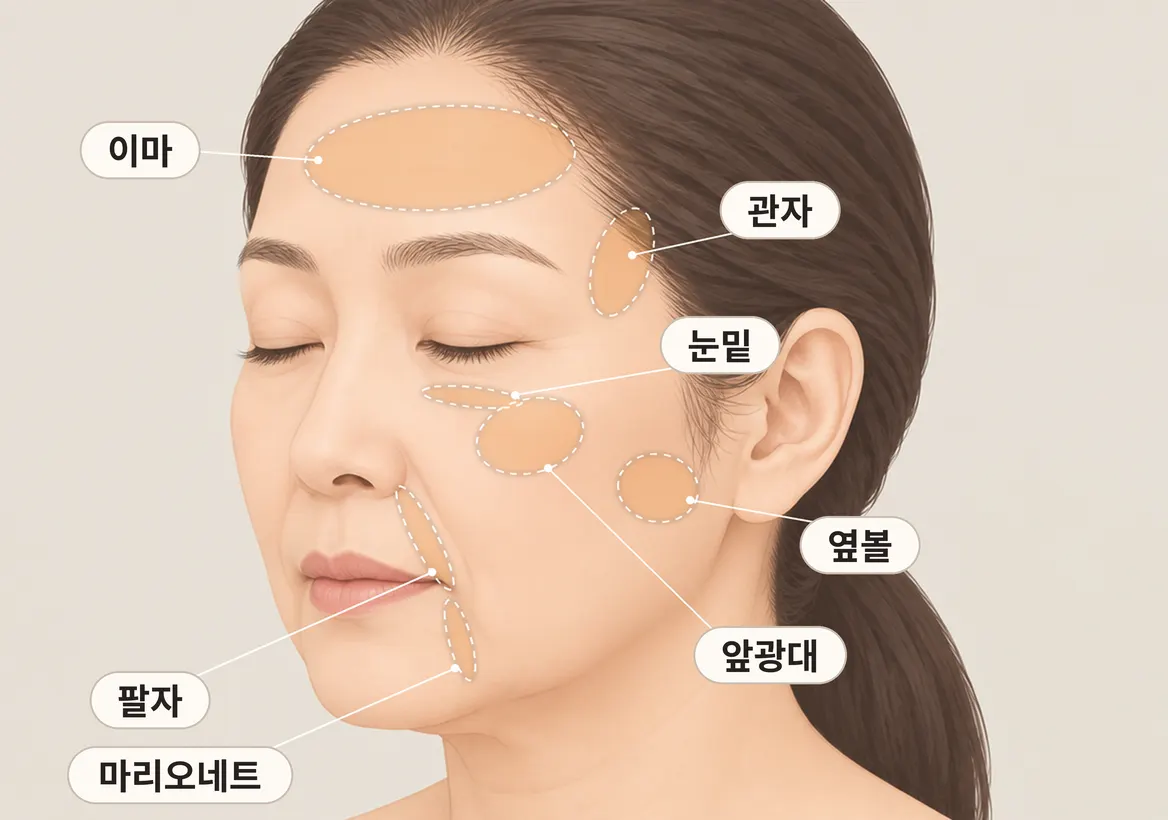
A facial fat graft is surgery in which your own fat, harvested from the abdomen or thighs, is purified and placed into hollow areas such as the forehead, temples, front of the cheeks, nasolabial folds, and under the eyes to restore volume.
It may be considered when flat or hollow areas of the face need more volume.
Facial Fat Graft (Fat Transfer) at a glance
- Surgery time
- About 1 hour
- Anesthesia
- IV sedation
- Hospital stay
- Not required
- Face washing
- From 2 days after surgery
- Swelling & bruising
- 1–2 weeks
- Return to daily life
- 1 week
These may vary depending on the grafted areas, the amount of fat, and any combined procedures.
Quick answer
When is a facial fat graft recommended?
A facial fat graft may be considered when hollow areas need volume, for example when a flat or sunken forehead makes the profile look flat, or when volume loss with age has hollowed the front of the cheeks and deepened the nasolabial folds. It uses your own fat, and the areas and amounts are planned by looking at the volume balance of the whole face.
What is a facial fat graft?
A facial fat graft is surgery in which your own fat, harvested from the abdomen or thighs, is purified and placed into hollow areas such as the forehead, temples, front cheek, nasolabial folds, and under the eyes to restore volume. Because it uses your own tissue, foreign-body reactions are uncommon. It is generally known that about 70% of the grafted fat survives and about 30% is absorbed, so the plan takes the absorbed amount into account.
A meta-analysis of 31 studies (1,572 patients) of facial fat grafting found patient satisfaction of 95% and complications in 3.4% (Ma et al., 2023).
When a facial fat graft may be needed
- A flat or sunken forehead makes the profile look flat
- Hollow temples make the facial contour look uneven
- Volume loss with age has hollowed the front of the cheeks and deepened the nasolabial folds
- Hollow under-eyes cast shadows and make you look tired
- Hollow side cheeks below the cheekbones make the cheekbones stand out (a "peanut-shaped" face)
- Hollow marionette lines at the corners of the mouth look deep
- Uneven facial fat distribution, and you want smoother contours
Fat graft by area
Forehead fat graft
A forehead fat graft may be considered when a flat or sunken forehead makes the profile look flat, or when forehead wrinkles and hollowing above the brows occur together. The forehead is a large area, so it is important to plan the amount and curve carefully, and it can also help when the shape of the forehead bone is the cause.
Front cheek and nasolabial fold fat graft
With age, the front cheek loses volume and becomes hollow, and the nasolabial folds deepen; filling these areas with fat can help the face look softer. Nasolabial folds are often caused by cheek sagging, so we check whether the cause is volume loss or sagging and then decide whether a fat graft or a lifting procedure is more suitable.
Side cheek fat graft
When the side cheeks below the cheekbones are hollow and the area between the cheekbones and jaw looks sunken, filling the side cheeks with fat can soften the contour.
Marionette (mouth corner) fat graft
When the marionette lines running from the corners of the mouth toward the chin are hollow and look deep, fat can be added to help soften them. If they are caused by sagging cheeks and jawline, lifting is considered as well.
Under-eye fat graft
When hollow under-eyes cast shadows or make you look tired, small amounts of fat are placed under the eyes, a little at a time. An under-eye fat graft may be done on its own, but under-eye fat bulging and hollowing often occur together, so it is frequently combined with under-eye fat repositioning.
Temple and upper eyelid fat graft
Fat can also be placed in areas that look hollow, such as the temples, to smooth the contour that runs from the forehead to the cheeks. Fat grafting for sunken upper eyelids is explained in detail on the Sunken Eyelid Fat Graft page.
Learn more about under-eye fat repositioning →Learn more about the sunken eyelid fat graft →Learn more about the thread lift →
Can a fat graft help a peanut-shaped face or a face that looks wide?
Can a fat graft help a peanut-shaped face (hollow side cheeks)?
A peanut-shaped face is a face shape in which the side cheeks below the cheekbones are hollow, so the area between the cheekbones and jaw looks sunken; filling the hollow side cheeks with fat can soften the contour. Once the side cheeks are filled, the cheekbones can look less prominent and the facial contour flows more smoothly, which may give a softer impression.
Can a fat graft help when the face looks wide or the cheekbones stand out?
When the temples, the front of the cheeks, and the side cheeks are hollow, the cheekbones can stand out between them and the face can look wider. Filling the hollow temples, front cheek, and side cheeks with fat together reduces the unevenness around the cheekbones so they look less prominent, and the facial lines flow smoothly, which may help the face look smaller and softer.
How a facial fat graft is performed
- 1
Fat harvesting
Fat is harvested from the abdomen or thighs with a thin tube (cannula).
- 2
Fat purification
The fat is separated in a centrifuge, and only the fat to be grafted is purified.
- 3
Design & injection
The fat is injected in small portions into the needed areas, focusing on the hollow areas.
- 4
Finishing
Gauze is placed on the harvest site, and healing tape is applied to the grafted areas.
What we check during a facial fat graft consultation
- Hollow areas and how much volume is lacking
- Whether the cause is volume loss or sagging
- Volume balance of the whole face
- Left–right asymmetry
- Bone structure, such as the shape of the forehead bone
- Amount of fat at the harvest site
- History of previous fillers or fat grafts
Facial fat graft recovery and swelling
After a fat graft, swelling and bruising are most noticeable on days 2–3 after surgery and gradually decrease, and returning to daily life usually takes about 1 week. The thighs or abdomen where fat was harvested may have muscle-ache-like pain and widespread bruising for about 1 week, and by about 1–2 months, the fat that does not survive has been absorbed and the remaining volume settles.
Next day
- Light strolls and walking allowed
2 days
- Gauze removed from the harvest site
- Face washing allowed (remove the facial healing tape after washing)
2–3 days
- Swelling and bruising at their peak
3 days
- Makeup allowed on areas without wounds
First 3–5 days
- Raise your pillow to keep your head above your heart
First week
- Muscle-ache-like pain and bruising at the harvest site gradually improve
- Use waterproof tape on the harvest site when showering
First 2 weeks
- Do not rub or press on the treated areas
- Avoid big smiles and frowning
First 4 weeks
- Avoid smoking, alcohol, strenuous exercise, swimming, baths, saunas, and heated spas
- If fat was grafted to the forehead or temples, avoid tight hats for 1 month
1–2 months
- The fat that does not survive has been absorbed, and the remaining volume settles
After 2–3 months
- Consider an additional graft if volume is lacking
Facial fat graft side effects and precautions
An analysis of 43 studies (4,577 patients) of facial fat grafting found complications in 2.27%, most of which were asymmetry (Gornitsky et al., 2019).
What are the possible side effects of a fat graft?
After a fat graft, besides temporary swelling, bruising, and pain at the harvest site, there may rarely be nodules where fat clumps and feels lumpy, calcification, left–right asymmetry, or volume loss from more absorption than expected.
Can the volume be reduced if too much fat was grafted?
If too much fat was grafted or the area is lumpy, the amount can be reduced with liposuction or fat removal. However, fat that has survived is attached to the surrounding tissue and is difficult to remove completely, and the correction method varies with the area and amount, so this is checked during the consultation.
Contact the clinic if you have these symptoms
Contact the clinic if you have severe pain not controlled by pain medication, continuous bleeding, a feeling of heat, or significant swelling on one side only.
Facial Fat Graft (Fat Transfer) FAQ
What is the survival rate of a fat graft?
The survival rate of a fat graft depends on the grafted area, how the fat is processed, and your constitution and healing, and some of the grafted fat is absorbed while the rest settles. It is generally known that about 70% survives and about 30% is absorbed, so the plan takes the absorbed amount into account. Avoiding smoking and pressure on the grafted area after surgery helps the fat survive.
How long do fat graft results last?
Fat that survives a fat graft settles as your own tissue and tends to last a long time. By about 1–2 months, the fat that does not survive has been absorbed and the remaining volume settles; after that, it may change along with aging or weight changes. If volume is lacking, an additional graft can be considered.
Can a fat graft be repeated?
A fat graft can be repeated, and it is considered when much of the fat was absorbed and volume is lacking, or when you want to better balance different areas. An additional graft is often done after 2–3 months, once the previously grafted fat has settled. Grafting in several smaller sessions rather than a large amount at once may be better for fat survival and a natural result.
How is a fat graft different from fillers?
A fat graft uses your own fat and tends to last a long time once it survives, while fillers are simple injections but are absorbed over time, so they last for a limited period. A fat graft is often considered for larger areas or longer-lasting volume, and fillers for quickly correcting small areas. A fat graft requires fat harvesting and has a longer recovery than fillers.
If I gain or lose weight after a fat graft, will the grafted area change?
After a fat graft, the surviving fat keeps the characteristics of fat from the harvest site, so if you gain or lose a lot of weight, the volume of the grafted area may change as well. To keep results stable, it is best to avoid sudden weight changes after surgery.
How is the cost of a fat graft determined?
The cost of a facial fat graft depends on the number and extent of grafted areas, how the fat is processed, and whether it is combined with other procedures. Because the areas and amounts needed vary with your face, an exact cost can be given after consultation.
Your doctor

Dr. Dahan Kim
Board-Certified Plastic Surgeon Medical Director, Steady Plastic Surgery
Steady Plastic Surgery is an eye-focused plastic surgery clinic in Gangnam (Sinnonhyeon), Seoul. Board-certified plastic surgeon Dr. Dahan Kim personally sees every patient from consultation to surgery and follow-up, focusing on double eyelid surgery, double eyelid revision, under-eye fat repositioning, lower blepharoplasty and middle-aged eye surgery.
- M.D. and master's degree, CHA University School of Medicine
- Plastic surgeon, CHA Bundang Medical Center
- Member, Korean Society of Plastic and Reconstructive Surgeons · Korean Society for Aesthetic Plastic Surgery · Korean Association of Plastic Surgeons
Have questions?
References
- Ma X, Huang J, Long X, et al. Quantifying outcomes of autologous fat transplantation in different facial deformities: A systemic review and meta-analysis. J Plast Reconstr Aesthet Surg. 2023;87:117-130. doi:10.1016/j.bjps.2023.09.007 PMID 37837945
- Gornitsky J, Viezel-Mathieu A, Alnaif N, et al. A systematic review of the effectiveness and complications of fat grafting in the facial region. JPRAS Open. 2019;19:87-97. doi:10.1016/j.jpra.2018.12.004 PMID 32158860