Upper Blepharoplasty (Upper Eyelid Lift)
Droopy eyelids, hooded eyes, double eyelid surgery for middle-aged eyelids

Upper blepharoplasty is a surgery that uses an incision along the double eyelid crease to remove sagging upper eyelid skin and address loose muscle and thick fat, and it is mainly performed when the eyelids have drooped with age.
It is considered when excess eyelid skin covers the lashes and makes your vision feel obstructed, or makes your eyes look small and sleepy.
Upper Blepharoplasty at a glance
- Surgery time
- 1 to 1.5 hours
- Anesthesia
- Local anesthesia or IV sedation
- Stitch removal
- 7 days after surgery
- Swelling & bruising
- 1–2 weeks
- Return to daily life
- 1 week
- Contact lenses
- 4 weeks after surgery
This may vary depending on combined procedures (ptosis correction, lower blepharoplasty, etc.) and the individual.
Quick answer
When is upper blepharoplasty recommended?
Upper blepharoplasty is considered when sagging upper eyelid skin covers the lashes and makes your vision feel obstructed, or makes your eyes look small and sleepy. Because the sagging skin is removed along the crease and a new double eyelid line is created in its place, it is, simply put, double eyelid surgery for middle-aged eyelids. If the eye-opening muscle is weak, ptosis correction is combined, and if you want to keep your existing crease while addressing sagging toward the outer corner, a sub-brow lift is considered.
What is upper blepharoplasty?
Upper blepharoplasty is, simply put, double eyelid surgery for middle-aged eyelids: it addresses loose eyelid skin, muscle, and thick fat and creates a new double eyelid line in their place. It is considered when excess skin covers the lashes and makes your vision feel obstructed, or makes your eyes look small and sleepy, and when the eye-opening muscle is weak, ptosis correction is sometimes performed at the same time.
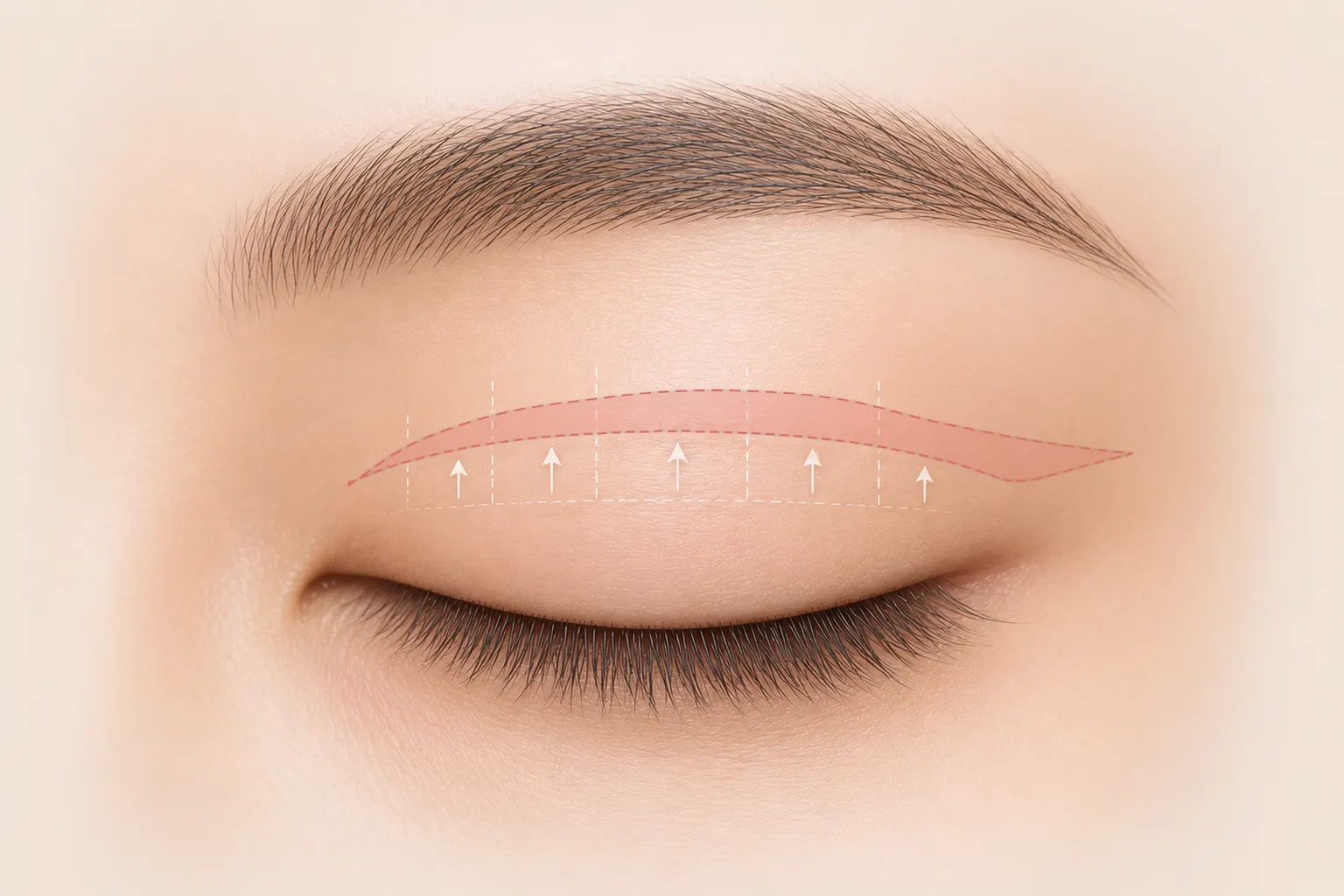
It has been reported that the key to surgery for upper eyelids that have drooped with age is correcting the sagging skin, and that creating a double eyelid line at the same time can help reduce recurrence of sagging (Cho, 2013).
Who is upper blepharoplasty right for?
- Drooping eyelids cover the pupils and make your vision feel obstructed
- The eyelid skin has lost elasticity overall and sags significantly
- You have no double eyelid and want to create a natural crease this time
- Your existing double eyelid line has developed multiple folds or faded with age and needs refining
- Your lashes are pressed down by sagging skin, poking your eyes and causing frequent tearing
- Your eyelid skin is thin
- A combined procedure such as ptosis correction is needed
Why do eyelids droop?
Droopy eyelids mainly develop with age as skin elasticity decreases and the muscles and supporting tissues around the eyes loosen. Ptosis, in which the eye-opening muscle weakens, or drooping of the eyebrows themselves can also be a cause, and long-term contact lens use or a habit of rubbing the eyes may contribute as well.
In a study of 5,578 European adults, 17.8% had sagging eyelid skin (dermatochalasis), and it was more common with older age (Jacobs et al., 2014).
How is middle-aged double eyelid surgery different from standard double eyelid surgery?
Upper blepharoplasty is the same as double eyelid surgery in that the crease is created through an incision along the double eyelid line, but more skin is removed than in double eyelid surgery. Also, middle-aged eyelids have lower skin elasticity, so the line can loosen or sagging skin can cover the line again more easily; fixation therefore needs to be done more carefully so that the double eyelid settles into a natural shape.
If you are worried about looking harsh
The biggest reason people in middle age hesitate about upper blepharoplasty is the worry that their appearance will look stronger or harsher after surgery. The more skin is removed, the greater the change in appearance, so options such as planning a lower, natural line that accounts for the sagging skin, or using lighter fixation to reduce the change in appearance, are considered together. If an excessive change in impression is expected, a sub-brow lift or brow lift is considered instead.
Upper blepharoplasty, sub-brow lift, brow lift, or ptosis correction: it depends on the cause
The right surgery among upper blepharoplasty, sub-brow lift, endoscopic brow lift, and ptosis correction depends on the cause. The key difference between upper blepharoplasty and a sub-brow lift is whether you want to keep your current eye shape and appearance, or change the structure and line of your eyes.
| Recommended surgery | Features | |
|---|---|---|
| When changing the double eyelid shape | Upper blepharoplasty | Sagging skin is removed through an incision along the double eyelid line, and ptosis correction and fat contouring can be done through the same incision |
| Sagging toward the outer corner, minimal change in appearance | Sub-brow lift | The incision is below the eyebrow, so the double eyelid line and eye shape do not change much |
| The eyebrow itself has drooped (with forehead wrinkles) | Endoscopic brow lift | The whole forehead is lifted to raise the position of the drooping eyebrows themselves |
| Weak eye-opening strength | Ptosis correction | The length of the eye-opening muscle is adjusted to strengthen eye opening |
When a sub-brow lift is the better fit
A sub-brow lift is considered when your existing double eyelid line already looks natural and you want to keep it, when you have thick skin and do not want a change in appearance, when thick eyelid skin makes it likely that you would look harsh after upper blepharoplasty, or when skin at the outer corner sags so much that it becomes irritated. A study of 64 Asian women who underwent a sub-brow lift also listed indications such as wanting to keep the existing double eyelid line and having sagging toward the outer corner as the main concern (Kim et al., 2008).
If the eyebrows have drooped, a brow lift is also considered
If droopy eyelids are caused not by the eyelid skin but by drooping of the eyebrows themselves, cutting only the skin below the eyebrow may not solve the problem. When an endoscopic brow lift and upper blepharoplasty are combined, lifting the eyebrows first changes the amount of remaining eyelid skin, so it is important to set the eyebrow position first and then remove only as much eyelid skin as needed.
The eyebrows may look lower after surgery
If you used your forehead muscles a lot to open your eyes, the eyebrows may look lower after the sagging skin is removed and the forehead effort decreases. A pooled analysis of studies on eyebrow position after upper blepharoplasty found that eyebrow height decreased by an average of 1.45 mm (Liu et al., 2023). That is why eyebrow position and forehead effort are checked before surgery.
Detailed comparison: upper blepharoplasty vs. sub-brow lift →Choosing surgery by cause of sagging (Middle-Aged Eye Surgery) →Learn more about the sub-brow lift →Learn more about the endoscopic brow lift →
When upper blepharoplasty is combined with ptosis correction
In middle-aged patients who have long relied on their forehead to open their eyes, upper blepharoplasty that only removes sagging skin may not solve the difficulty in opening the eyes, so the eyes may still look sleepy or droop again. In middle age, skin sagging and ptosis often occur together, so eye-opening strength is checked before surgery, and if needed, ptosis correction is performed through the same incision.
A study of 20,941 Koreans aged 40 and older found that age-related ptosis was present in 13.5%, increasing with age (Kim et al., 2017). In a study that examined 2,530 candidates for upper blepharoplasty, 13.7% had ptosis they were not aware of (Eshraghi et al., 2023). That is why, for eyelids that droop with age, both skin sagging and ptosis are checked when planning correction (Lee et al., 2020).
How much upper eyelid fat should be removed?
If the upper eyelids look thick and puffy because of fat, an appropriate amount of fat can be reduced during double eyelid surgery or upper blepharoplasty. However, removing too much can make the upper eyelids look sunken later, so we first determine whether the thickness comes from fat, skin, or muscle and remove only what is truly needed.
It has been reported that preserving orbital fat is important to prevent hollowing when operating on upper eyelids that have drooped with age (Park, 2015). If the upper eyelids are already sunken, a fat graft is sometimes considered together with upper blepharoplasty.
How upper blepharoplasty is performed
- 1
Design
The condition of the drooping eyelids is analyzed to determine the incision line and how much skin to remove.
- 2
Skin and fat contouring
An incision is made along the double eyelid line, and loose skin, muscle, and thick fat are removed as needed.
- 3
Crease fixation
A new double eyelid line is created. It is often planned as a low, natural line that accounts for the sagging skin, and if eye-opening strength is weak, ptosis correction is performed through the same incision.
- 4
Closure
The incision is closed, and stitches are removed 7 days after surgery.
What we check in an upper blepharoplasty consultation
A one-size-fits-all plan that ignores the points below rarely gives a satisfying result, so we check them together.
- The thickness of the eyelid skin and how much it sags
- The distance between the eye and the eyebrow
- How much you use your forehead muscles when opening your eyes
- Eye-opening strength (whether ptosis is present)
- How much sagging there is toward the outer corner
- The amount of upper eyelid fat and whether there is hollowing
- Whether you want a double eyelid and how you feel about a change in appearance
Upper blepharoplasty recovery
Returning to daily life after upper blepharoplasty usually takes about 1 week, and stitches are removed 7 days after surgery. Most of the major swelling is expected to go down in about 4–6 weeks.
Days 2–3 after surgery
- Swelling and bruising peak
First 3–5 days
- Sleep with your head elevated
- Cold compresses for the first 7 days
Day 7
- Stitches removed
- Gentle face washing from the day after stitch removal
After 4 weeks
- Makeup on the incision area and contact lenses are OK
- Alcohol, smoking, saunas and strenuous exercise can be resumed, no earlier than 4 weeks after surgery
4–6 weeks
- Most of the major swelling goes down
Makeup on areas without incisions is OK from 3 days after surgery.
Upper blepharoplasty side effects and precautions
What are the side effects of upper blepharoplasty?
After upper blepharoplasty, besides temporary swelling, bruising, a feeling that the eyes do not fully close, and dryness, rare side effects may include asymmetry, a line that looks high or thick, scarring, and difficulty closing the eyes because too much skin was removed. Early symptoms often improve as swelling subsides, but if they persist, additional correction may be needed. It is important to plan the amount of skin removal precisely before surgery.
Can the upper eyelids become sunken after upper blepharoplasty?
When a lot of fat was removed during double eyelid surgery or upper blepharoplasty, the upper eyelids may become sunken over time. That is why we first determine whether the thickness comes from fat, skin, or muscle and remove only what is truly needed.
Upper Blepharoplasty FAQ
How long is recovery after upper blepharoplasty?
Returning to daily life after upper blepharoplasty usually takes about 1 week, and stitches are removed 7 days after surgery. Swelling and bruising peak on days 2–3, and most of the major swelling is expected to go down in about 4–6 weeks. Face washing is OK from the day after stitch removal, makeup on the incision area and contact lenses from 4 weeks, and alcohol, smoking, saunas, and strenuous exercise are also best avoided for 4 weeks.
Can exercise or massage improve droopy eyelids?
Droopy eyelids are difficult to improve with exercise or massage. Stretched skin and loosened tissue do not shrink with exercise, and frequently rubbing around the eyes can actually irritate the skin. If the drooping blocks your vision or makes your eyes look sleepy, the cause is checked and surgical correction is considered.
Can upper and lower blepharoplasty be done at the same time?
Upper and lower blepharoplasty can be performed together. If you have both upper eyelid sagging and under-eye fat or sagging, doing them at once means going through recovery only once. However, the surgery takes longer and swelling may be greater, so we decide whether to do them together or separately after checking your health and eye condition.
Can an endoscopic brow lift and upper blepharoplasty be done together?
An endoscopic brow lift and upper blepharoplasty can be performed together. Eyebrow drooping and eyelid skin sagging often occur together, and because lifting the eyebrows first changes the amount of remaining eyelid skin, it is important to set the eyebrow position with the brow lift first and then remove only as much eyelid skin as needed. Whether to do both at once or separately is decided during the consultation.
How is the cost of upper blepharoplasty determined?
The cost of upper blepharoplasty depends on the extent of skin removal, whether combined procedures such as fat contouring or ptosis correction are included, and whether it is a revision. The scope of surgery differs depending on your eyelid condition, so an exact cost can be provided after a consultation.
Your doctor

Dr. Dahan Kim
Board-Certified Plastic Surgeon Medical Director, Steady Plastic Surgery
Steady Plastic Surgery is an eye-focused plastic surgery clinic in Gangnam (Sinnonhyeon), Seoul. Board-certified plastic surgeon Dr. Dahan Kim personally sees every patient from consultation to surgery and follow-up, focusing on double eyelid surgery, double eyelid revision, under-eye fat repositioning, lower blepharoplasty and middle-aged eye surgery.
- M.D. and master's degree, CHA University School of Medicine
- Plastic surgeon, CHA Bundang Medical Center
- Member, Korean Society of Plastic and Reconstructive Surgeons · Korean Society for Aesthetic Plastic Surgery · Korean Association of Plastic Surgeons
Have questions?
References
- Cho I. Aging blepharoplasty. Arch Plast Surg. 2013;40(5):486-491. doi:10.5999/aps.2013.40.5.486 PMID 24086798
- Jacobs LC, et al. Intrinsic and extrinsic risk factors for sagging eyelids. JAMA Dermatol. 2014;150(8):836-843. doi:10.1001/jamadermatol.2014.27 PMID 24869959
- Kim YS, Roh TS, Yoo WM, Tark KC, Kim J. Infrabrow excision blepharoplasty: applications and outcomes in upper blepharoplasty in Asian women. Plast Reconstr Surg. 2008;122(4):1199-1205. doi:10.1097/PRS.0b013e3181858fc0 PMID 18827656
- Liu R, et al. Brow position change and its potential risk factors following upper blepharoplasty: a systematic review and meta-analysis. Aesthetic Plast Surg. 2023;47(4):1394-1409. doi:10.1007/s00266-023-03288-0 PMID 36890345
- Kim MH, Cho J, Zhao D, Woo KI, Kim YD, Kim S, Yang SW. Prevalence and associated factors of blepharoptosis in Korean adult population: The Korea National Health and Nutrition Examination Survey 2008-2011. Eye (Lond). 2017;31(6):940-946. doi:10.1038/eye.2017.43 PMID 28338663
- Eshraghi B, et al. The prevalence of undiagnosed ptosis among candidates for upper eyelid blepharoplasty. Aesthet Surg J Open Forum. 2023;5:ojad079. doi:10.1093/asjof/ojad079 PMID 37694225
- Lee TY, Shin YH, Lee JG. Strategies of upper blepharoplasty in aging patients with involutional ptosis. Arch Plast Surg. 2020;47(4):290-296. doi:10.5999/aps.2020.01361 PMID 32718105
- Park DD. Aging Asian upper blepharoplasty and brow. Semin Plast Surg. 2015;29(3):188-200. doi:10.1055/s-0035-1556853 PMID 26306086
- 박대환, 백봉수, Nahai F. 안성형외과학. 제3판. 군자출판사; 2009. ISBN 978-89-6278-139-7. [in Korean]
- Cho I. The Art of Blepharoplasty. Koonja Publishing; 2017. ISBN 979-11-5955-234-2.
- 대한미용성형외과학회. 미용성형외과학 2. 제2판. 군자출판사; 2023. ISBN 979-11-7068-001-7. [in Korean]