Lower Blepharoplasty (Lower Eyelid Surgery)
Under-eye wrinkles, under-eye sagging, midface lift

Lower blepharoplasty is a surgery that uses an incision just below the lash line to reposition or contour bulging under-eye fat, tighten loose skin and muscle, and remove excess skin.
It is mainly considered when bulging under-eye fat (eye bags) comes with sagging skin and fine wrinkles.
Lower Blepharoplasty at a glance
- Surgery time
- 1 hour – 1 hour 30 minutes
- Anesthesia
- IV sedation or local anesthesia
- Compression tape
- Removed 2 days after surgery
- Stitch removal
- Around 7 days after surgery
- Swelling & bruising
- 1–2 weeks
- Return to daily life
- 1 week
This may vary depending on combined procedures (fat graft, midface lift, etc.) and the individual.
Quick answer
When is lower blepharoplasty recommended?
If bulging under-eye fat comes with sagging skin and fine wrinkles, correcting the position of the fat alone may not be enough, so lower blepharoplasty is recommended. It is most common in people in their 50s and older, but it may also be needed in the 40s if skin sagging is significant. What matters is not age but the current anatomical changes under the eyes.
What is lower blepharoplasty?
In lower blepharoplasty, an incision is made just below the lash line to reposition or contour the fat, remove as much loose skin as needed, and secure the loosened orbicularis oculi muscle to the periosteum. Because skin is removed, the position and support structures of the eyelid are considered together so that only the necessary amount of skin is adjusted.
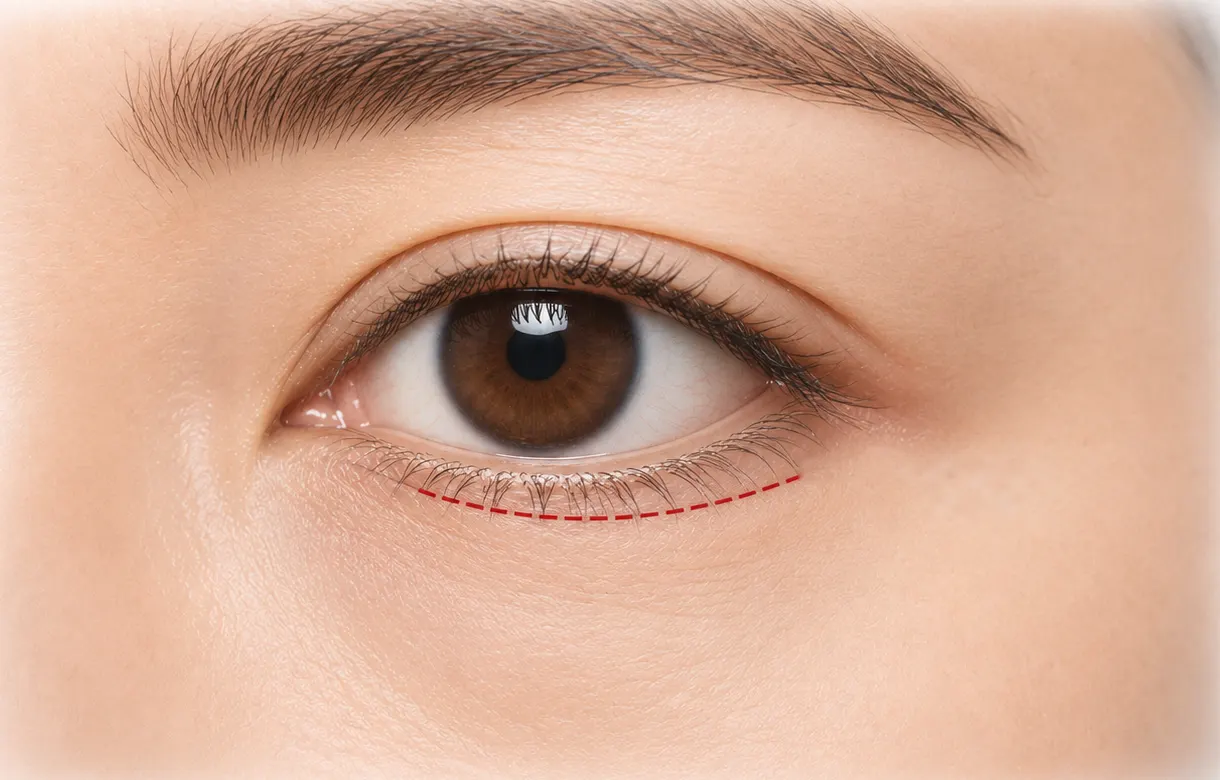
Under-eye wrinkles and sagging: when lower blepharoplasty is needed
If the skin sags along with bulging fat: lower blepharoplasty
If bulging under-eye fat comes with sagging skin and fine wrinkles, correcting the position of the fat alone may not be enough, so lower blepharoplasty is recommended. It is most common in people in their 50s and older, but it may also be needed in the 40s if skin sagging is significant.
If the tear trough hollow is deeper than the fat bulge: lower blepharoplasty with a fat graft
When there is not much fat but the tear trough is deep, repositioning too much fat can actually make the hollow look more pronounced. In this case, we recommend repositioning only an appropriate amount of fat during lower blepharoplasty to soften the border, and adding the missing volume with a fat graft.
If the midface is also hollow and sagging: adding a midface lift
If bulging under-eye fat comes with midface volume loss and sagging, such as a broad hollow in the front of the cheek or deep nasolabial folds, fat repositioning alone may not be enough. In this case, a midface lift (SOOF lift) and a fat graft are considered together with lower blepharoplasty, because the under-eye area is connected to the midface.
How is lower blepharoplasty different from under-eye fat repositioning?
Under-eye fat repositioning reaches the bulging under-eye fat through the conjunctiva inside the eyelid (transconjunctival) and moves it into the hollow tear trough, while lower blepharoplasty uses an incision below the lash line to reposition fat and also address loose skin. The choice between the two depends on skin laxity and elasticity rather than age.
Learn more about under-eye fat repositioning →Detailed comparison: under-eye fat repositioning vs. lower blepharoplasty →
When a midface lift is added
Lower blepharoplasty addresses loose skin and bulging fat under the eyes, while a midface lift raises the sagging tissue of the front cheek below. At Steady Plastic Surgery, the midface lift is performed through the lower blepharoplasty incision, so it is done as an addition to lower blepharoplasty, and whether to add it is decided based on how much the midcheek sags and whether there is ectropion (outward turning of the lower eyelid).
What is a midface lift?
A midface lift is a surgery that lifts and secures the sagging tissue of the midface, which runs from below the eyes to the front of the cheek. At Steady Plastic Surgery, the layer between the periosteum and the fat beneath the orbicularis oculi muscle (SOOF) is released through the lower blepharoplasty incision, and the sagging tissue is lifted and secured with sutures. It is performed as an addition to lower blepharoplasty.
When is a midface lift recommended?
A midface lift is considered when the tissue over the cheekbone area has descended with age, leaving a pronounced hollow in the upper cheek, or when this sagging has deepened the nasolabial folds. Lower blepharoplasty alone addresses the skin and fat under the eyes but does not lift a sagging midcheek, so when midface sagging is present, a midface lift is added to create a smooth line from below the eyes to the front of the cheek. It may also be performed preventively when ectropion is present or the risk of developing it is high.
What are the recovery and scarring like after a midface lift?
Because a midface lift is performed through the lower blepharoplasty incision, it does not create any additional scar beyond that incision. Recovery is the same as for lower blepharoplasty: returning to daily life usually takes about 1 week, the under-eye compression tape is removed 2 days after surgery, and stitches are removed around 7 days after surgery. Swelling and bruising peak on days 2–3, and it is best to wait 4 weeks before wearing contact lenses, using saunas, or doing strenuous exercise.
How is ectropion (lower eyelid turning outward) prevented?
Ectropion is a condition in which the lower eyelid turns outward and droops, and it is related to the elasticity of the lower eyelid. It is more likely to occur when skin is removed from an eyelid with weak elasticity, so lower eyelid elasticity is tested before lower blepharoplasty.
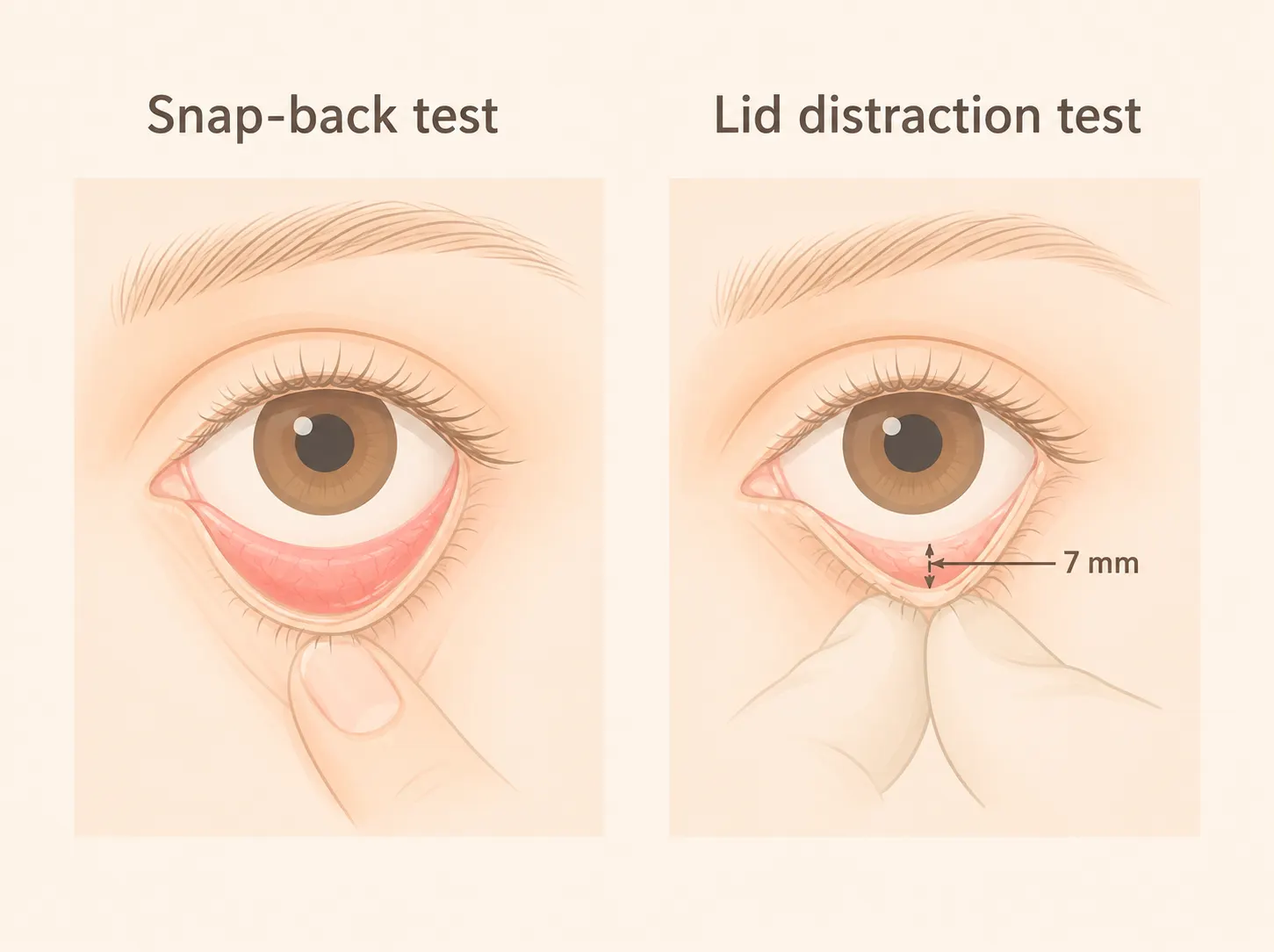
- Snap-back test: the lower eyelid is pulled down and released to see how well it returns to its position
- Lid distraction test: the lower eyelid is pulled forward to see how far it separates from the eye
Why does ectropion occur after lower blepharoplasty?
Ectropion after lower blepharoplasty can occur when a lot of skin was removed or when the lower eyelid has weak elasticity, as swelling or scarring pulls the lower eyelid downward. Mild ectropion in the early stage often improves as swelling subsides, but if it persists, lateral canthopexy or a correction that adds skin, such as a skin graft, may be needed. To prevent this, eyelid elasticity is checked before surgery, and when needed, orbicularis oculi muscle suspension, a midface lift, or lateral canthopexy is planned and performed at the same time.
How lower blepharoplasty is performed
An incision is made just below the lash line, the under-eye fat is addressed, excess skin is removed, and the incision is closed.
- 1
Skin incision
An incision is made in the skin just below the lash line.
- 2
Layered dissection
The layer beneath the skin and the layer beneath the muscle (orbicularis oculi) are dissected one by one.
- 3
Preseptal and preperiosteal dissection
A space is created for the fat to be moved into.
- 4
Fat repositioning
The bulging fat is repositioned into the hollow area below. Some fat is removed if needed.
- 5
Additional procedures
If needed, orbicularis oculi muscle suspension, midface lift and lateral canthopexy are performed together.
- 6
Skin removal
Excess skin is removed as needed.
- 7
Skin closure
The incision is closed.
What do we check in a lower blepharoplasty consultation?
What matters is not age but the current anatomical changes under the eyes. During the consultation, we check the following before deciding on the approach.
- How much the under-eye fat bulges
- How deep the tear trough is
- The amount, thickness, and elasticity of the skin
- How much the eyelid sags or has loosened
- The border between the eyelid and the cheek
- Midface volume and sagging
- Left–right differences
- Any previous surgery around the eyes
- Hollowing and sagging in other areas of the face
Lower blepharoplasty recovery and scars
Returning to daily life after lower blepharoplasty usually takes about 1 week. Swelling and bruising peak on days 2–3, and it is best to wait 4 weeks before wearing contact lenses, using saunas, or doing strenuous exercise.
Day 2 after surgery
- Under-eye compression tape removed
- Rest for 2–3 days to prevent re-bleeding
Days 2–3 after surgery
- Swelling and bruising peak
First 3–5 days
- Sleep with your head elevated
- Cold compresses for the first 7 days
Before stitch removal
- Wash your face, avoiding the under-eye area and upper cheeks
Around day 7 after surgery
- Stitches removed
- Gentle face washing and makeup from the next day
After 4 weeks
- Contact lenses are OK
- Alcohol, smoking, saunas and strenuous exercise can be resumed
Does lower blepharoplasty leave a scar?
Lower blepharoplasty involves a skin incision, so it does leave a scar, but because the incision is placed just below the lash line, it is often hard to notice after recovery. There may be redness early on that gradually fades over several months, and how visible the scar becomes depends on skin type, constitution, and aftercare.
Lower blepharoplasty side effects and precautions
What are the side effects of lower blepharoplasty?
After lower blepharoplasty, besides temporary swelling, bruising, tearing, and a foreign-body sensation, rare side effects may include ectropion (the lower eyelid drooping or turning outward), under-eye hollowness, asymmetry, and scarring. Temporary symptoms mostly improve within 1–6 months, but if they persist, additional treatment or revision surgery may be needed.
Why can the under-eye area look hollow after lower blepharoplasty?
Under-eye hollowness after lower blepharoplasty can occur mainly when too much under-eye fat was removed or too much fat was repositioned. To reduce this, careful planning before surgery and repositioning an appropriate amount are important. If a hollow has already formed, adding volume with a fat graft or similar method can be considered.
When is revision lower blepharoplasty needed?
Revision lower blepharoplasty is considered when under-eye hollowness develops, bulging fat remains, the lower eyelid droops or turns outward, or the scar is noticeable. Revision is usually done after 6 months, once the tissue has stabilized, and the approach depends on the amount of skin and tissue condition left after the previous surgery, so an accurate diagnosis is important. If there is a functional problem such as the eyelid turning outward, it is best to be seen first regardless of timing.
Lower Blepharoplasty FAQ
How long does lower blepharoplasty take, and what anesthesia is used?
Lower blepharoplasty usually takes 1 hour to 1 hour 30 minutes, and both IV sedation and local anesthesia are available. It takes longer if a fat graft or another procedure is combined, and the anesthesia method is decided during the consultation after reviewing your health and the scope of surgery.
Does lower blepharoplasty also improve under-eye wrinkles?
Because lower blepharoplasty tightens and removes loose skin, under-eye wrinkles caused by sagging skin often improve. However, expression lines that appear when smiling or fine lines in the skin texture itself may not disappear completely with surgery, so botulinum toxin or skin treatments are sometimes considered as well.
How long do the results of lower blepharoplasty last?
The results of lower blepharoplasty tend to last a long time. Because bulging fat is repositioned and excess skin is removed, it is uncommon to return to the pre-surgery state, but skin elasticity continues to decline with age, so some sagging may return over time. How long the results last varies with skin condition and lifestyle.
Can upper and lower blepharoplasty be done at the same time?
Upper and lower blepharoplasty can be performed together. If you have both upper eyelid sagging and under-eye fat or sagging, doing them at once means going through recovery only once. However, the surgery takes longer and swelling may be greater, so we decide whether to do them together or separately after checking your health and eye condition.
How is the cost of lower blepharoplasty determined?
The cost of lower blepharoplasty depends on whether fat repositioning or a fat graft is combined, the extent of skin removal, and whether additional corrections such as a midface lift or lateral canthopexy are included. The scope of surgery can differ greatly depending on your under-eye condition, so an exact cost can be provided after a consultation.
How is the cost of a midface lift determined?
A midface lift is added to lower blepharoplasty, and its cost depends on the scope of the lower blepharoplasty and whether combined procedures such as fat repositioning or a fat graft are included. An exact cost can be provided after a consultation.
Your doctor

Dr. Dahan Kim
Board-Certified Plastic Surgeon Medical Director, Steady Plastic Surgery
Steady Plastic Surgery is an eye-focused plastic surgery clinic in Gangnam (Sinnonhyeon), Seoul. Board-certified plastic surgeon Dr. Dahan Kim personally sees every patient from consultation to surgery and follow-up, focusing on double eyelid surgery, double eyelid revision, under-eye fat repositioning, lower blepharoplasty and middle-aged eye surgery.
- M.D. and master's degree, CHA University School of Medicine
- Plastic surgeon, CHA Bundang Medical Center
- Member, Korean Society of Plastic and Reconstructive Surgeons · Korean Society for Aesthetic Plastic Surgery · Korean Association of Plastic Surgeons
Have questions?
References
- Atiyeh B, Chrabieh E, Makkawi K, Beaineh P, Issa O, Emsieh S. Transconjunctival or Transcutaneous Approach for Fat-preserving Lower Lid Blepharoplasty? Plast Reconstr Surg Glob Open. 2025;13(12):e7345. doi:10.1097/GOX.0000000000007345 PMID 41415593
- Gimenez AR, Rohrich R, Borab Z, et al. Safety and Complications in Lower Eyelid Blepharoplasty: A Systematic Review. Plast Reconstr Surg Glob Open. 2025;13(9):e7102. doi:10.1097/GOX.0000000000007102 PMID 40995580
- 박대환, 백봉수, Nahai F. 안성형외과학. 제3판. 군자출판사; 2009. ISBN 978-89-6278-139-7. [in Korean]
- Cho I. The Art of Blepharoplasty. Koonja Publishing; 2017. ISBN 979-11-5955-234-2.
- 대한미용성형외과학회. 미용성형외과학 2. 제2판. 군자출판사; 2023. ISBN 979-11-7068-001-7. [in Korean]