Under-Eye Fat Repositioning vs Lower Blepharoplasty
Skin laxity, incision site, and recovery
Under-eye fat repositioning and lower blepharoplasty (lower eyelid surgery) both improve under-eye bags and shadows, but they differ in whether there is sagging skin and where the incision is made.
What matters is not your age but the anatomical changes under your eyes right now.
At a glance
| Under-Eye Fat Repositioning | Lower Blepharoplasty | |
|---|---|---|
| Incision site | Conjunctiva on the inner side of the eyelid | Skin just below the lower lash line |
| Skin | Left as is | Excess skin removed as needed |
| Suitable for | Bulging fat with little skin laxity | Bulging fat plus sagging skin and fine wrinkles |
| Typical age range | 30s–40s | 50s and older |
| Compression tape | Removed after 2 days | Removed after 2 days |
| Stitch removal | Depends on the case (with or without stitches) | 7 days |
| Face washing | Wash with water after 3 days (if there are no stitches) | From the day after stitch removal |
| Contact lenses | After 4 weeks | After 4 weeks |
Age is only a rough guide. The method is decided after your under-eye area is examined at consultation.
Quick answer
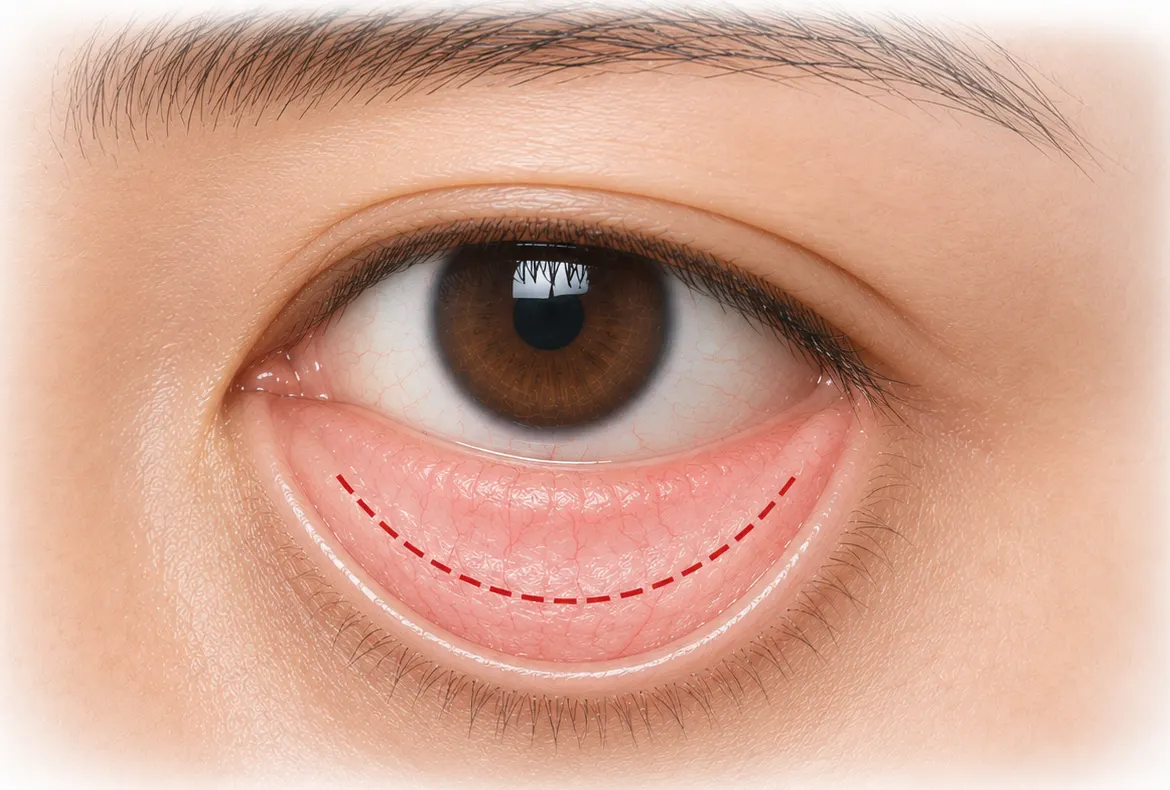
- Under-eye fat repositioning approaches through the conjunctiva on the inner side of the eyelid (transconjunctival), leaving no incision line on the skin. The bulging fat is moved into the hollow tear trough, and the septum that holds the fat is reinforced.
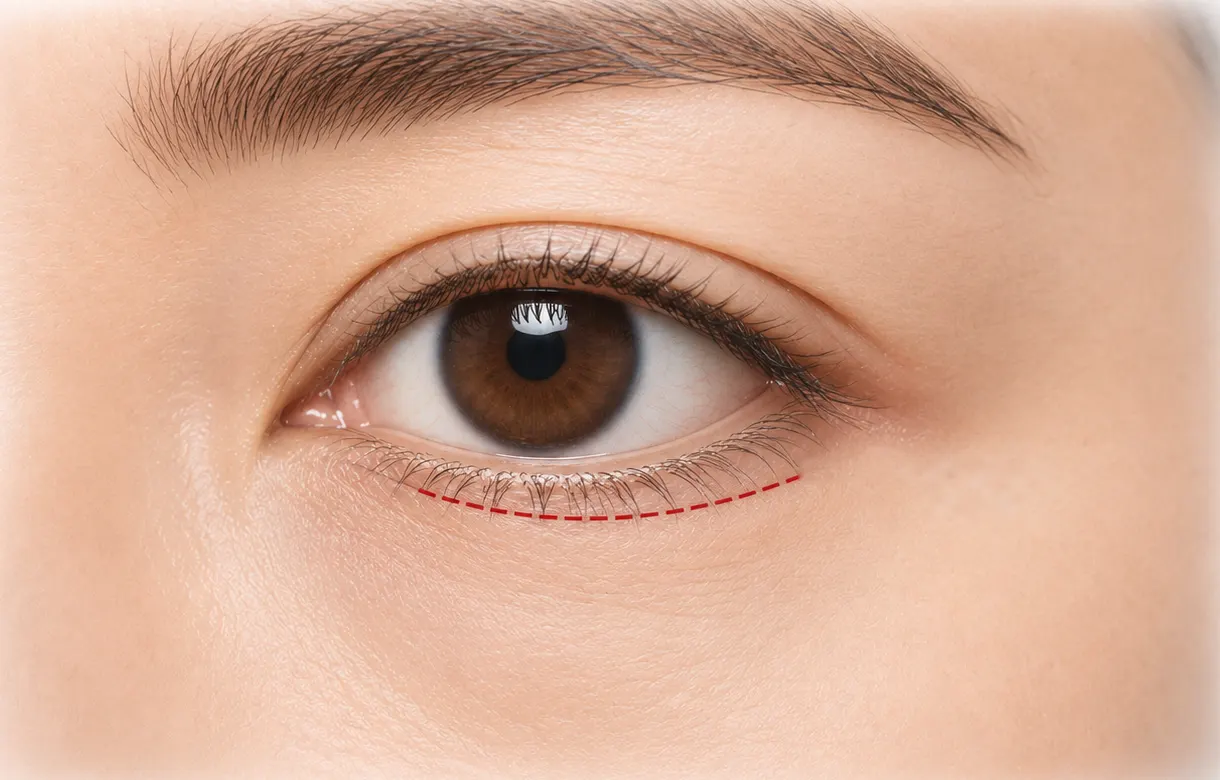
- Lower blepharoplasty opens the skin just below the lash line to reposition or trim the fat, removes excess skin as needed, and anchors the loosened orbicularis oculi muscle to the periosteum.
- If the fat bulges but there is little skin laxity, we recommend under-eye fat repositioning; if the skin has also loosened along with the bulging fat, we recommend lower blepharoplasty.
How is under-eye fat repositioning different from lower blepharoplasty?
The two surgeries differ in whether sagging skin is addressed and in where the incision is made.
Under-eye fat repositioning approaches through the conjunctiva on the inner side of the eyelid, leaving no incision line on the skin. The bulging fat is moved into the hollow tear trough, and the septum that holds the fat is reinforced.
Lower blepharoplasty opens the skin just below the lash line to reposition or trim the fat, removes excess skin as needed, and anchors the loosened orbicularis oculi muscle to the periosteum.
A systematic review comparing the transconjunctival and transcutaneous approaches concluded that both can be used safely for fat-preserving surgery, and that the transconjunctival approach is better suited to younger patients with good skin elasticity (Atiyeh et al., 2025).
Which surgery is considered for which under-eye condition?
Depending on the condition of your under-eye area, the options considered are as follows.
Bulging fat with little skin sagging: under-eye fat repositioning
When skin elasticity is preserved and bulging fat is the main issue, we recommend transconjunctival under-eye fat repositioning. It mostly applies to people in their 30s–40s, but it can also be an option in the 20s or 50s. If there is a bulge with a hollow below it, we preserve and reposition the fat rather than remove it, to soften the border between the lower eyelid and the cheek.
Bulging fat along with loose skin: lower blepharoplasty
If there is sagging skin and fine wrinkles along with bulging fat, correcting only the position of the fat may not be enough, so we recommend lower blepharoplasty. It is most common in people in their 50s and older, but it may also be needed in the 40s if the skin sags considerably. Because skin is removed, we take the eyelid position and its support structures into account and adjust only as much skin as needed.
A tear trough deeper than the fat bulge: lower blepharoplasty with a fat graft
When there is not much fat but the tear trough is deep, repositioning too much fat can make the hollow look even more prominent. In this case, we recommend lower blepharoplasty that repositions only the right amount of fat to soften the border, with a fat graft to add volume where it is lacking.
Hollowing and sagging extending to the midface: combining a midface lift
If there is volume loss and sagging in the midface, such as broad hollowing over the cheekbone area and deep nasolabial folds, along with bulging under-eye fat, fat repositioning alone may not be enough. In this case, a midface lift (SOOF lift) and a fat graft are considered along with lower blepharoplasty, because the under-eye area is connected to the midface.
What problems can occur if the wrong surgery is chosen?
If the skin sags considerably and only under-eye fat repositioning is done, the fat may be flattened but the skin may look more wrinkled and saggy.
Conversely, if there is no sagging and too much skin is removed with lower blepharoplasty, complications such as unnecessary scarring or ectropion (the lower eyelid turning outward) can occur. When skin elasticity is much reduced, lateral canthopexy is sometimes done at the same time to help prevent ectropion.
What do we check at consultation?
What matters is not your age but the anatomical changes under your eyes right now. At consultation, we check the following before deciding on the method.
- How much the under-eye fat bulges
- How deep the tear trough is
- The amount, thickness and elasticity of the skin
- How much the eyelid sags or has loosened
- The border between the lower eyelid and the cheek
- Volume and sagging of the midface
- Differences between the left and right sides
- Any previous surgery around the eyes
- Hollowing and sagging in other areas of the face
How does recovery differ?
For both surgeries, the under-eye compression tape is removed 2 days after surgery, and cold compresses are applied for 7 days. Swelling and bruising peak on days 2–3 after surgery; it is best to sleep with your head raised for 3–5 days and to rest for 2–3 days after surgery to help prevent bleeding. Contact lenses can be worn from 4 weeks after either surgery.
The difference lies in the skin incision. Lower blepharoplasty leaves stitches in the skin below the lash line, so until they are removed, wash the rest of your face but avoid the under-eye area and the front of the cheek; gentle face washing of the whole face is possible from the day after stitch removal. With under-eye fat repositioning, if there are no skin stitches, you can wash with water after 3 days and use a foaming cleanser after 7 days.
FAQ
How is under-eye fat repositioning different from lower blepharoplasty?
Under-eye fat repositioning is performed through the conjunctiva on the inner side of the eyelid and moves bulging under-eye fat into the hollow tear trough, while lower blepharoplasty opens the skin below the lash line to reposition the fat and also trim the loose skin. If skin sagging is minimal and bulging fat is the main issue, under-eye fat repositioning is often considered; if the skin is loose and wrinkled, lower blepharoplasty is often considered. The choice between them is based on skin laxity and elasticity rather than age.
Can under-eye fat repositioning be done if the under-eye area is hollow?
Under-eye fat repositioning can be done even when the under-eye area is hollow, but if there is little under-eye fat or the hollowing is severe, another procedure may be needed. Depending on the border between the under-eye area and the upper cheek, cheekbone size and the amount of fat over the front of the cheekbone, we plan repositioning, septal reinforcement, a midface lift or a fat graft. It is best to identify the cause first through a detailed consultation with a board-certified plastic surgeon.
References
- Atiyeh B, Chrabieh E, Makkawi K, Beaineh P, Issa O, Emsieh S. Transconjunctival or Transcutaneous Approach for Fat-preserving Lower Lid Blepharoplasty? Plast Reconstr Surg Glob Open. 2025;13(12):e7345. doi:10.1097/GOX.0000000000007345 PMID 41415593
- 박대환, 백봉수, Nahai F. 안성형외과학. 제3판. 군자출판사; 2009. ISBN 978-89-6278-139-7. [in Korean]
- Cho I. The Art of Blepharoplasty. Koonja Publishing; 2017. ISBN 979-11-5955-234-2.
- 대한미용성형외과학회. 미용성형외과학 2. 제2판. 군자출판사; 2023. ISBN 979-11-7068-001-7. [in Korean]
Have questions?