Non-Incisional (Natural Adhesion) vs Incisional Double Eyelid Surgery
Crease loosening, scars, recovery time, and how to read reviews
The biggest difference between non-incisional (natural adhesion) and incisional double eyelid surgery is whether the skin is incised, and which one suits you depends on how thick your eyelids are and how much they sag.
If you look through double eyelid surgery reviews, you will see claims that natural adhesion comes undone and that incisional results look obviously "done." Here we explain how the two methods differ and what to check when reading reviews.
At a glance
| Non-Incisional (Natural Adhesion) | Incisional | |
|---|---|---|
| Method | A thread is placed through tiny punctures to fix the crease, without a long skin incision | The skin is incised along the crease, skin and fat are trimmed as needed, and the crease is fixed |
| Suitable for | Thin eyelids with little sagging | Thick, puffy upper lids or sagging skin |
| Surgery time | 30 minutes | 1–1.5 hours |
| Anesthesia | Local anesthesia or IV sedation | Local anesthesia or IV sedation |
| Visible swelling | Mostly settles in 1–2 weeks | Mostly settles in 2–4 weeks |
| Until the crease looks natural | 2–4 weeks after surgery | 1–3 months after surgery |
| Stitch removal | Not needed | 7 days after surgery |
| Crease loosening | Relatively more likely | Rare, but possible |
| Eye makeup and contact lenses | After 4 weeks | After 4 weeks |
Figures vary by individual. The exact method and schedule are decided after your eyes are examined at consultation.
Quick answer
- Non-incisional (natural adhesion) double eyelid surgery creates the crease with a thread, without a long skin incision. Incisional double eyelid surgery creates the crease through a skin incision while trimming any tissue that needs it.
- Natural adhesion is often chosen for thin eyelids with little excess skin, and the incisional method for puffy upper lids or sagging skin.
- Natural adhesion usually involves less swelling and an easier recovery, but the crease is relatively more likely to loosen. With the incisional method the crease tends to settle more firmly, but a scar may be visible when the eyes are closed and recovery takes longer.
- A review shows the result on that person's eyes, so check how long after surgery the photo was taken and what their eyelids were like, not just the name of the method.
How is non-incisional (natural adhesion) double eyelid surgery different from incisional surgery?
The two methods differ in whether the skin is incised and, when it is not, in how the crease is held in place.
Non-incisional (natural adhesion) double eyelid surgery is one type of buried suture method. A thread placed through tiny punctures makes the skin adhere to the deeper tissue, forming the crease. Compared with a standard buried suture method, it focuses on improving how well the crease holds.
Incisional double eyelid surgery opens the skin along the crease, so excess skin or upper eyelid fat can be trimmed under direct view. There is also partial-incision double eyelid surgery, which opens only part of the eyelid. Which type of double eyelid surgery is right for you depends on the condition of your eyes.
Neither method is simply better; the question is which one fits your eyelids.
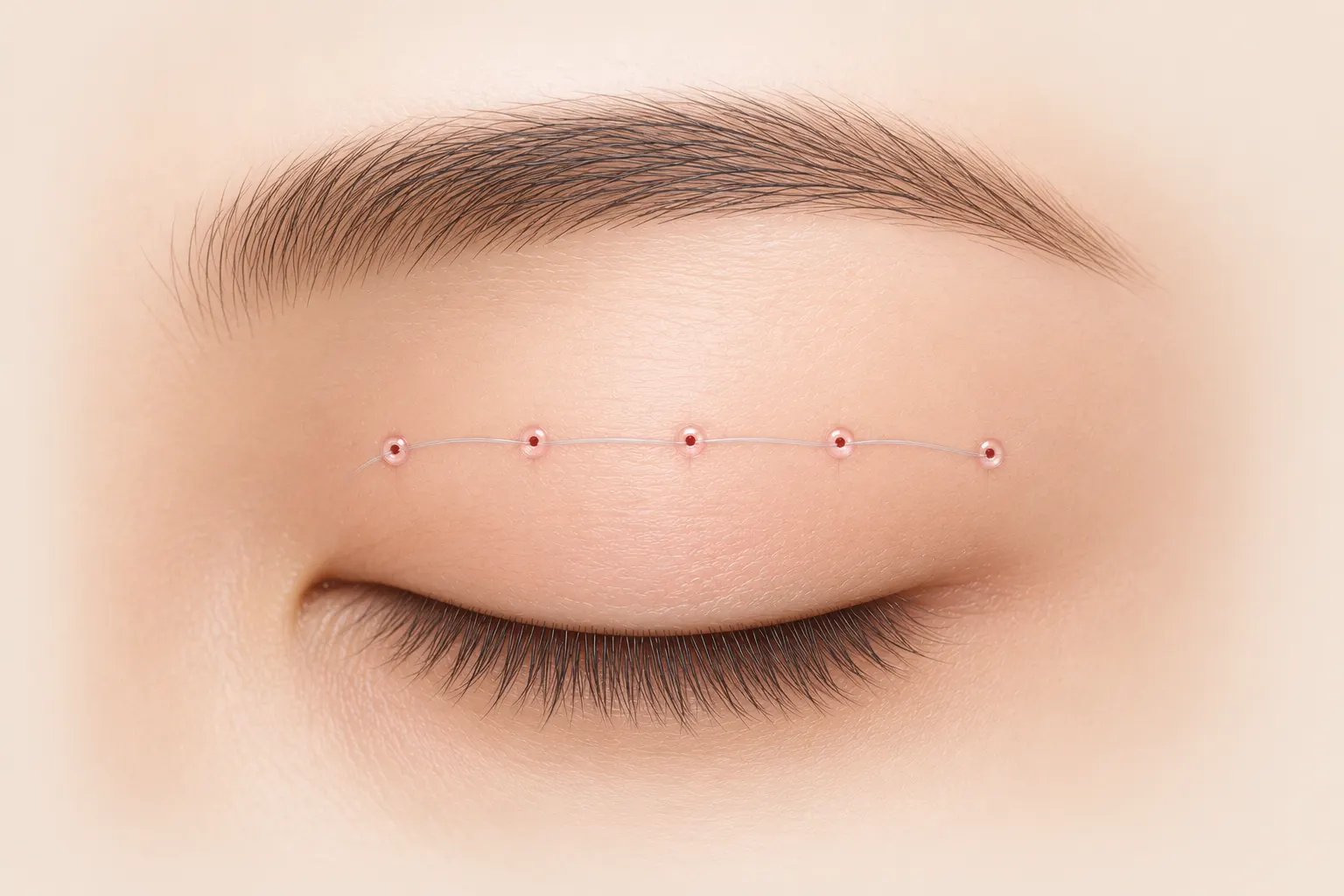
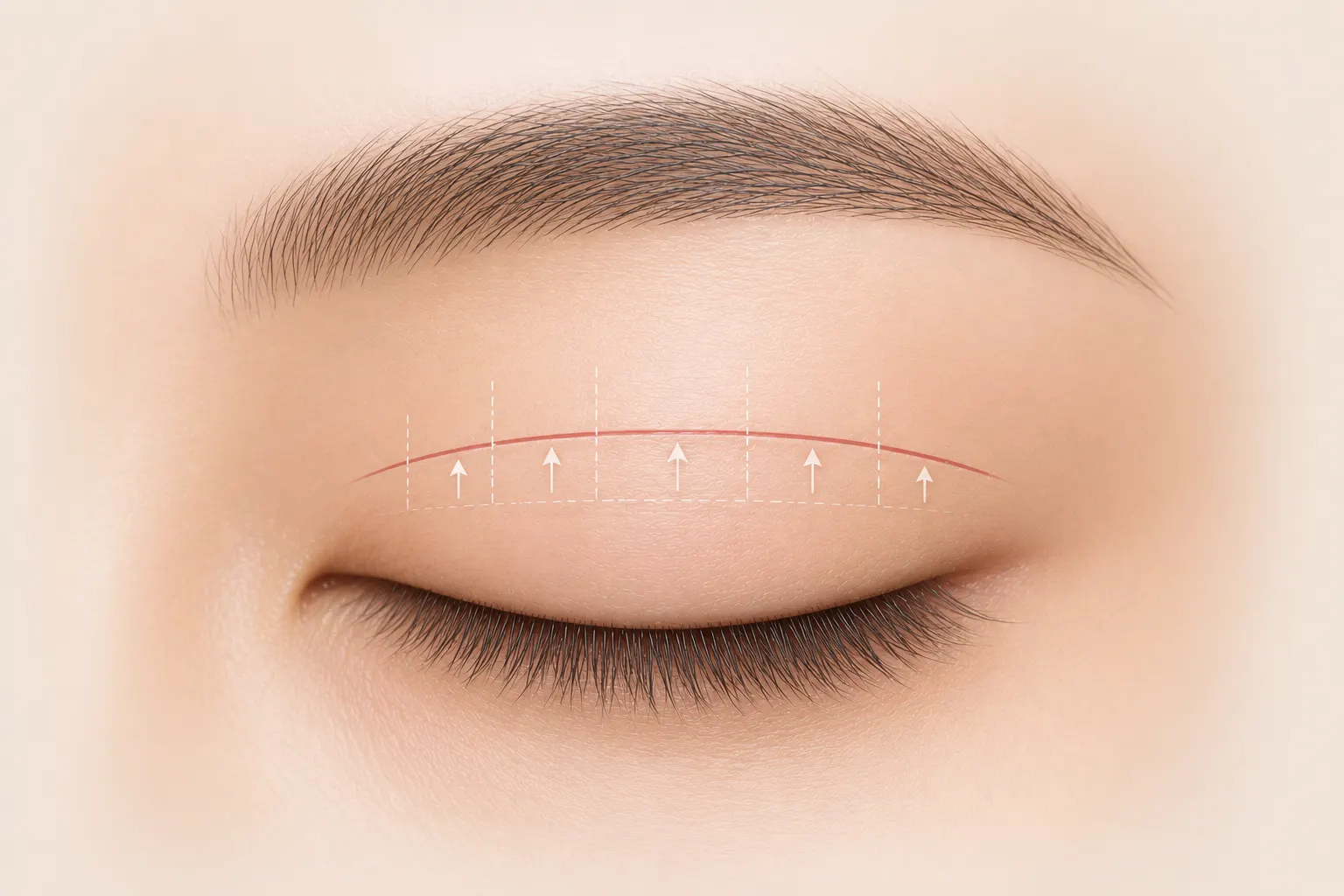
How do we decide between non-incisional (natural adhesion) and incisional double eyelid surgery?
In the clinic, we look at skin thickness, how much the eyelid sags, the fat in the upper eyelid, the strength of the eye-opening muscle, and the crease you want, among other factors.
- Skin thickness: the thinner the skin, the more often natural adhesion is considered
- Skin sagging: if there is sagging, the incisional method, which can trim the skin, is considered
- Upper eyelid fat: if there is too much or too little fat, the incisional method is considered
- Eye-opening strength: if it is weak enough that the eyelid covers the iris or the eyes look sleepy, ptosis correction is considered as well
- The crease you want: the method can also vary with your eye structure and the crease height you want
Not every double eyelid surgery needs ptosis correction; whether it is needed is decided after checking the strength of the eye-opening muscle.
Some eyes are suitable for both methods, so we examine your eyelids at consultation and compare the pros and cons before deciding.
Can a non-incisional (natural adhesion) double eyelid crease loosen?
A non-incisional (natural adhesion) double eyelid crease is relatively more likely to loosen than an incisional one, and an incisional crease can also loosen in rare cases.
Thick eyelids and a habit of rubbing the eyes often are factors that can make the crease fade. That is why it matters to assess eyelid thickness and tissue condition before surgery when choosing the method.
Non-incisional methods have been reported to have the drawback of the crease loosening more than incisional methods, and techniques that induce natural adhesion have been studied to reduce this (Jung, 2021).
In a retrospective comparison of 204 Korean patients, the crease loosened in 19.3% with interrupted buried sutures and in 8.6% with continuous buried sutures, so the loosening rate differed by fixation method even among buried suture techniques (Baek et al., 2015). Because that study used different techniques and patients, its figures cannot be applied directly to natural adhesion.
If the crease has already loosened, we first look at the cause. Eyes with thin eyelids and little sagging can be operated on again with natural adhesion. But if the cause was thick eyelids or very weak eye-opening strength, or if loosening has happened repeatedly, the same thing may happen again, so the incisional method is often recommended.
Does incisional double eyelid surgery leave a noticeable scar?
In most cases, the scar is not very noticeable.
The incision line is planned to sit within the double eyelid crease. So it is usually not visible when the eyes are open, but the line may show when the eyes are closed.
Early on it may look red and feel firm, and it fades over several months. How much it shows depends on skin type, constitution and aftercare.
Because non-incisional (natural adhesion) surgery does not involve a long skin incision, scarring is often not noticeable, but the possibility of the crease loosening described above should also be considered.
How should you read double eyelid surgery reviews?
A review shows the result on that person's eyes, so first check how long after surgery the photo was taken and what their eyelids were like, rather than the name of the method. Whether you are reading natural adhesion or incisional double eyelid reviews, check the following.
- When the photo was taken: how many days or weeks after surgery
- Method: natural adhesion or incisional
- Eye condition: whether the eyelid thickness, sagging, bulging or hollowing is similar to yours
- Swelling: whether it was taken while swelling was still present
The crease takes about 2–4 weeks to settle with natural adhesion and about 1–3 months with the incisional method. Photos taken earlier than this may not show the final look, so when comparing reviews it helps to compare photos taken at a similar stage.
How do swelling and recovery time differ between natural adhesion and incisional double eyelid surgery?
Visible swelling usually settles considerably in 1–2 weeks with natural adhesion and in 2–4 weeks with the incisional method. Swelling and bruising peak on days 2–3 after surgery and then gradually subside, and they tend to last longer with a higher crease or thicker skin.
The schedule after surgery differs by method, as follows.
From day 3
With natural adhesion, you can wash your face with water and wear makeup except on the treated area
Day 7
With natural adhesion, you can use a foaming cleanser; with the incisional method, stitches are removed on this day and gentle face washing starts the next day
Weeks 2–4
Visible swelling settles, and with natural adhesion the crease starts to look natural
After 4 weeks
Eye makeup, contact lenses, alcohol, smoking, swimming, saunas and strenuous exercise are allowed (avoid them for the first 4 weeks after surgery)
Months 1–3
With the incisional method, the crease starts to look natural
Apply cold compresses for 7 days after surgery, and sleep with your head raised on a higher pillow for 3–5 days. Many people return to work a few days after natural adhesion, and after stitch removal with the incisional method.
What options are considered if non-incisional (natural adhesion) double eyelid surgery is not suitable?
Depending on your eyelids, incisional double eyelid surgery or combining it with ptosis correction is considered.
- If the crease has loosened repeatedly because of thick eyelids or excess fat: the incisional method is often recommended
- If there is sagging skin that needs to be trimmed: the incisional method is considered
- If weak eye-opening strength lets the eyelid cover the iris and makes the eyes look sleepy: ptosis correction is considered as well
The method is decided after directly examining the existing crease and the remaining tissue.
FAQ
How is non-incisional (natural adhesion) double eyelid surgery different from incisional double eyelid surgery?
Non-incisional (natural adhesion) double eyelid surgery fixes the crease with a thread placed through tiny punctures, without a long skin incision. Incisional double eyelid surgery opens the skin along the crease, trims excess skin or fat as needed, and then fixes the crease. Natural adhesion usually involves less swelling and an easier recovery. The incisional method can correct the eyelid's condition at the same time, and the crease tends to settle more firmly. Rather than one being better, what matters is choosing the method that suits your eyes.
What is non-incisional (natural adhesion) double eyelid surgery?
Non-incisional (natural adhesion) double eyelid surgery is one type of buried suture method: without a skin incision, a thread encourages the skin and deeper tissue to adhere naturally, forming the crease. It focuses on improving how well the crease holds compared with a standard buried suture method. If the eyelids are thick or the skin sags, the incisional method may be more suitable, so we decide after examining your eyelids at consultation.
Can the crease loosen after double eyelid surgery?
A double eyelid crease can fade or loosen over time if the eyelids are thick or you often rub your eyes, and this is relatively more likely with non-incisional methods. That is why it matters to assess eyelid thickness and tissue condition before surgery when choosing the method.
If a natural adhesion double eyelid crease loosens, can it be redone with natural adhesion?
If a natural adhesion double eyelid crease has loosened, it can be redone with natural adhesion when the eyelids are thin and there is little sagging skin. However, if it loosened because of thick eyelids or excess fat, or has loosened several times, it may loosen again for the same reason, so the incisional method is often recommended. We decide the method after checking the existing crease and the remaining tissue.
When does the crease start to look natural after double eyelid surgery?
How long it takes for a double eyelid crease to look natural varies a lot from person to person, but it usually takes 2–4 weeks with natural adhesion and about 1–3 months with the incisional method. Even after visible swelling has gone, the crease may look deep for a while; it gradually looks more natural as the remaining swelling subsides and the tissue softens. Rather than judging the result by how it looks at this stage, it is better to follow how it progresses.
References
- Jung GS. Natural Adhesion Blepharoplasty Technique. J Craniofac Surg. 2021;32(2):e220-e222. doi:10.1097/SCS.0000000000006761 PMID 33705081
- Baek JS, Ahn JH, Jang SY, Chee E, Jang JW. Comparison Between Continuous Buried Suture and Interrupted Buried Suture Methods for Double Eyelid Blepharoplasty. J Craniofac Surg. 2015;26(7):2174-2176. doi:10.1097/SCS.0000000000001984 PMID 26413962
- 박대환, 백봉수, Nahai F. 안성형외과학. 제3판. 군자출판사; 2009. ISBN 978-89-6278-139-7. [in Korean]
- Cho I. The Art of Blepharoplasty. Koonja Publishing; 2017. ISBN 979-11-5955-234-2.
- 대한미용성형외과학회. 미용성형외과학 2. 제2판. 군자출판사; 2023. ISBN 979-11-7068-001-7. [in Korean]
Have questions?