Ptosis Correction vs Double Eyelid Surgery
Purpose, checking for ptosis, and recovery
Double eyelid surgery and ptosis correction (droopy eyelid surgery) have different purposes.
Many people who are advised to have double eyelid surgery and ptosis correction together ask how the two surgeries differ.
At a glance
| Ptosis Correction | Double Eyelid Surgery | |
|---|---|---|
| Area treated | Back layer of the eyelid (eye-opening muscle) | Front layer of the eyelid (skin) |
| Purpose | Strengthens the eye-opening force itself | Folds up eyelid skin that hangs over the eye |
| What is corrected | Length of the eye-opening muscles (levator and Müller's muscle) | Eyelid skin and crease |
| Suitable for | Eyelid ptosis with weak eye-opening strength | Pseudoptosis, where skin hangs over the eye |
| Swelling | Non-incisional 1–2 weeks / incisional 2–4 weeks | Natural adhesion 1–2 weeks / incisional 2–4 weeks |
Doing the two surgeries together does not usually make swelling much worse or recovery much longer.
Quick answer
- Double eyelid surgery folds up eyelid skin that hangs over the eye, while ptosis correction adjusts the length of the eye-opening muscle to strengthen the eye-opening force itself.
- If eye-opening strength is normal, double eyelid surgery alone is often enough; if there is eyelid ptosis, ptosis correction needs to be combined for a more alert, defined look.
- If the crease is simply made higher and wider without checking this, the eyes may look even sleepier or end up with an unnatural, heavy "sausage-like" crease.
Double eyelid surgery and ptosis correction have different purposes
The eyelid has a front layer made of skin and a back layer made of the eye-opening muscle, and if either one droops, it covers the iris. When the front layer droops, double eyelid surgery folds up the skin of the front layer; when the back layer droops, ptosis correction tightens and lifts the muscle of the back layer.
Double eyelid surgery folds up eyelid skin that hangs over the eye. Ptosis correction adjusts the length of the eye-opening muscle (the levator or Müller's muscle) to strengthen the eye-opening force itself.
If eye-opening strength is normal, double eyelid surgery alone is often enough. In pseudoptosis, where sagging skin hangs over the lid margin and makes the eyes look small, double eyelid surgery alone can make the eyes look larger. On the other hand, if there is eyelid ptosis, where weak eye-opening strength lets the upper eyelid cover the iris, ptosis correction needs to be combined for a more alert, defined look.
If the crease is simply made higher and wider without checking this, the eyes may look even sleepier or end up with an unnatural, heavy "sausage-like" crease.
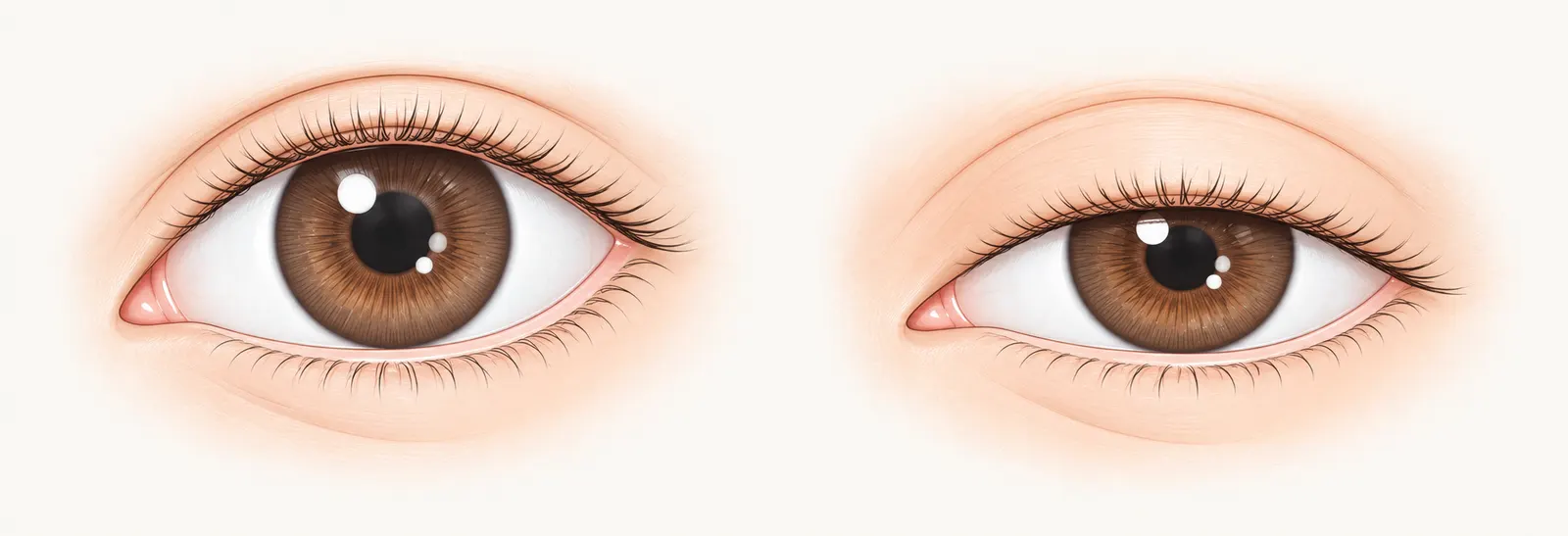
Eyelid ptosis is more common than you might think
Eyelid ptosis is a condition in which the upper eyelid covers the iris because the eye-opening muscle is weak or its connection to the eyelid has loosened. It can be present from birth, or it can develop later with aging, long-term contact lens wear or a habit of rubbing the eyes often.
A study analyzing 20,941 Koreans aged 40 and older who took part in the Korea National Health and Nutrition Examination Survey found that the prevalence of age-related ptosis was 13.5%, rising with age from 5.4% in people in their 40s to 32.8% in those aged 70 and older (Kim et al., 2017).
Even if your eyelid height is within the normal range, if you are using your forehead to keep your eyes open, you may have hidden (subclinical) ptosis. Research shows that subclinical ptosis is common in Asian patients having cosmetic upper eyelid surgery, and that correcting the ptosis component as well is important for predictable results (Wong et al., 2024).
Check in the mirror whether you might need ptosis correction
However, to assess eye-opening strength accurately, it must be checked with the forehead muscles blocked and pseudoptosis ruled out. So treat the self-check as a reference only; in practice, we decide after directly checking the strength of the eye-opening muscle at consultation.
- When looking straight ahead, the top of the iris is covered by 1–2 mm or more
- People often tell you that you look sleepy or tired
- When opening your eyes, you unconsciously raise your forehead, causing deep forehead wrinkles
- When you tuck your chin and look up, your eyelids feel heavy and your eyes do not open easily
- Even after double eyelid surgery, your eyes still look heavy
In middle age, sagging skin also needs to be assessed
In middle-aged people who have long relied on the forehead to open their eyes, upper blepharoplasty that only removes sagging skin may not solve the difficulty in opening the eyes, so the eyes may still look sleepy or droop again. In middle age, sagging skin and eyelid ptosis often occur together, so we check eye-opening strength before surgery and, if needed, perform ptosis correction through the same incision.
Too much or too little correction both cause problems
Overcorrecting ptosis in an eye with normal eye-opening strength can keep the eyes from closing fully or make them look as if they are staring, giving a harsh impression. After ptosis correction, incomplete eyelid closure, overcorrection, undercorrection, left-right asymmetry and loss of correction can occur. Eye-opening muscle strength differs from person to person and between the left and right sides, so we adjust the amount of correction while checking how far the eyes open during surgery.
If overcorrection or asymmetry persists after the swelling has gone down, revision is considered.
Recovery
Swelling and recovery time after ptosis correction are similar to double eyelid surgery, and doing it together with double eyelid surgery does not usually make swelling much worse or recovery much longer. Visible swelling usually settles considerably in 1–2 weeks with the non-incisional method and in 2–4 weeks with the incisional method.
Apply cold compresses for 7 days after surgery. Swelling and bruising peak on days 2–3, and it is best to sleep with your head raised for 3–5 days. Avoid alcohol and smoking for at least 4 weeks, and contact lenses can be worn from 4 weeks after surgery. Makeup can be applied to areas without wounds from 3 days after surgery, and to the sutured area from 4 weeks after surgery.
FAQ
How is non-incisional ptosis correction different from incisional ptosis correction?
Non-incisional ptosis correction tightens the eye-opening muscle with a thread placed through tiny punctures, without a skin incision, while incisional ptosis correction opens the double eyelid crease so the muscle can be examined and corrected directly. The non-incisional method involves less swelling and an easier recovery, so it suits mild drooping. The incisional method is mainly chosen when a larger correction is needed, when the eyes differ in size, or for revision surgery.
Can ptosis correction be done without a double eyelid?
Yes, ptosis correction can be done without creating a visible double eyelid; this is often called monolid ptosis correction. Strictly speaking, a thin, low crease that stays hidden when the eyes are open (an in-fold crease) is created at the same time. It is considered when you want to keep a monolid look while showing more of the iris.
How is ptosis correction different for men?
Ptosis correction for men focuses on improving a sleepy or tired look, and the amount of correction is adjusted so the eyes do not look overly large. Men often have thick eyelids and a short distance between the eyebrow and eye, so overcorrection can make the face look harsh. Whether to do ptosis correction alone without a double eyelid or to also create a low crease is decided at consultation based on your facial features.
References
- Kim MH, Cho J, Zhao D, Woo KI, Kim YD, Kim S, Yang SW. Prevalence and associated factors of blepharoptosis in Korean adult population: The Korea National Health and Nutrition Examination Survey 2008-2011. Eye (Lond). 2017;31(6):940-946. doi:10.1038/eye.2017.43 PMID 28338663
- Wong CH, Hsieh MKH, Mendelson B. Subclinical Upper Eyelid Ptosis in Asian Patients: The Role of Levator Advancement in Optimizing Outcomes in "Cosmetic" Upper Blepharoplasty. Aesthetic Plast Surg. 2024;48(2):141-151. doi:10.1007/s00266-023-03697-1 PMID 37821553
- 박대환, 백봉수, Nahai F. 안성형외과학. 제3판. 군자출판사; 2009. ISBN 978-89-6278-139-7. [in Korean]
- Cho I. The Art of Blepharoplasty. Koonja Publishing; 2017. ISBN 979-11-5955-234-2.
- 대한미용성형외과학회. 미용성형외과학 2. 제2판. 군자출판사; 2023. ISBN 979-11-7068-001-7. [in Korean]
Have questions?