Upper Blepharoplasty vs Sub-Brow Lift
Incision site, change in appearance, and scars
Upper blepharoplasty (upper eyelid lift) and a sub-brow lift are among the most common eye surgeries people seek in middle age for droopy, hooded eyelids.
Both remove sagging skin, but they differ in where the incision is made and how much your appearance changes after surgery.
At a glance
| Upper Blepharoplasty | Sub-Brow Lift | |
|---|---|---|
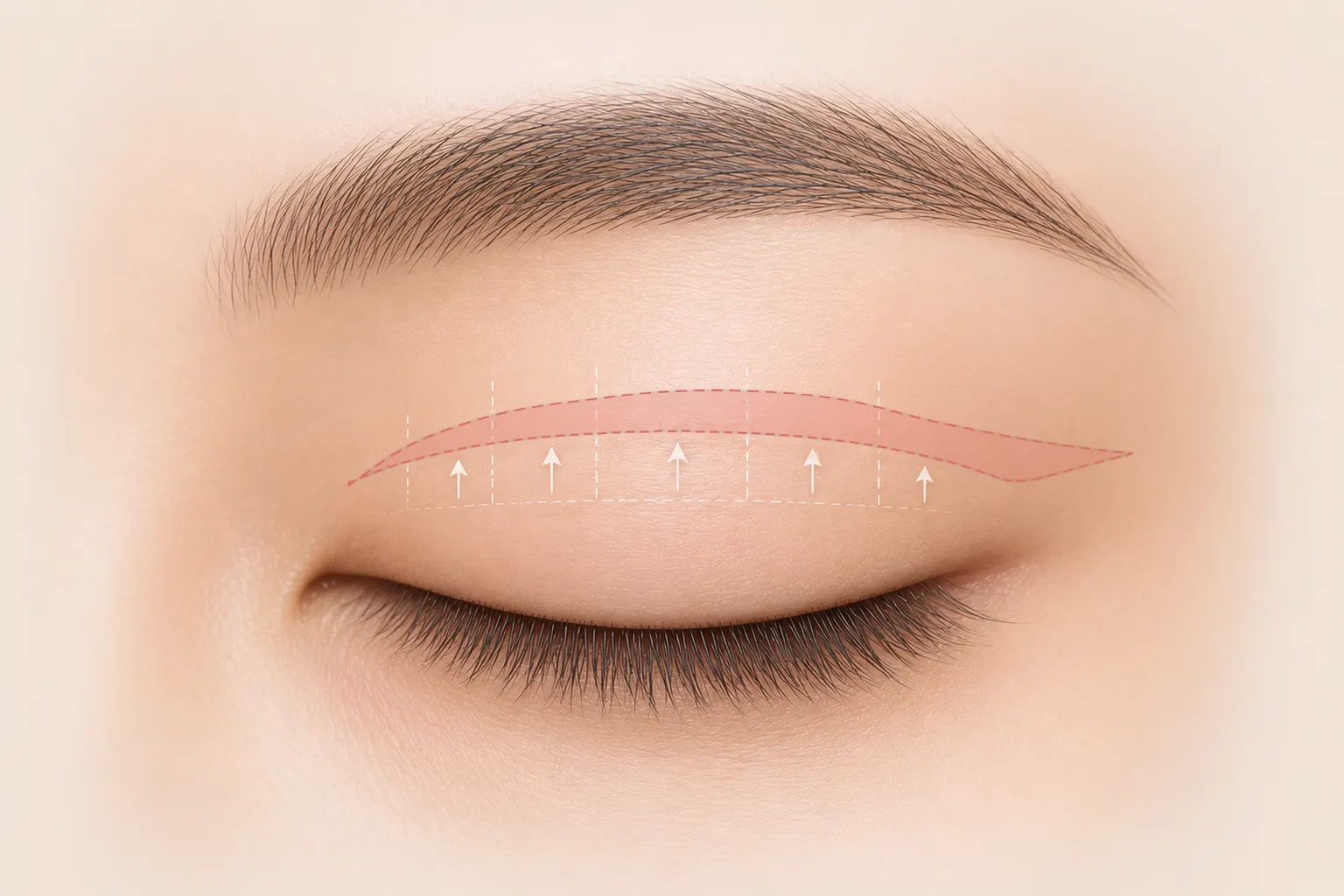
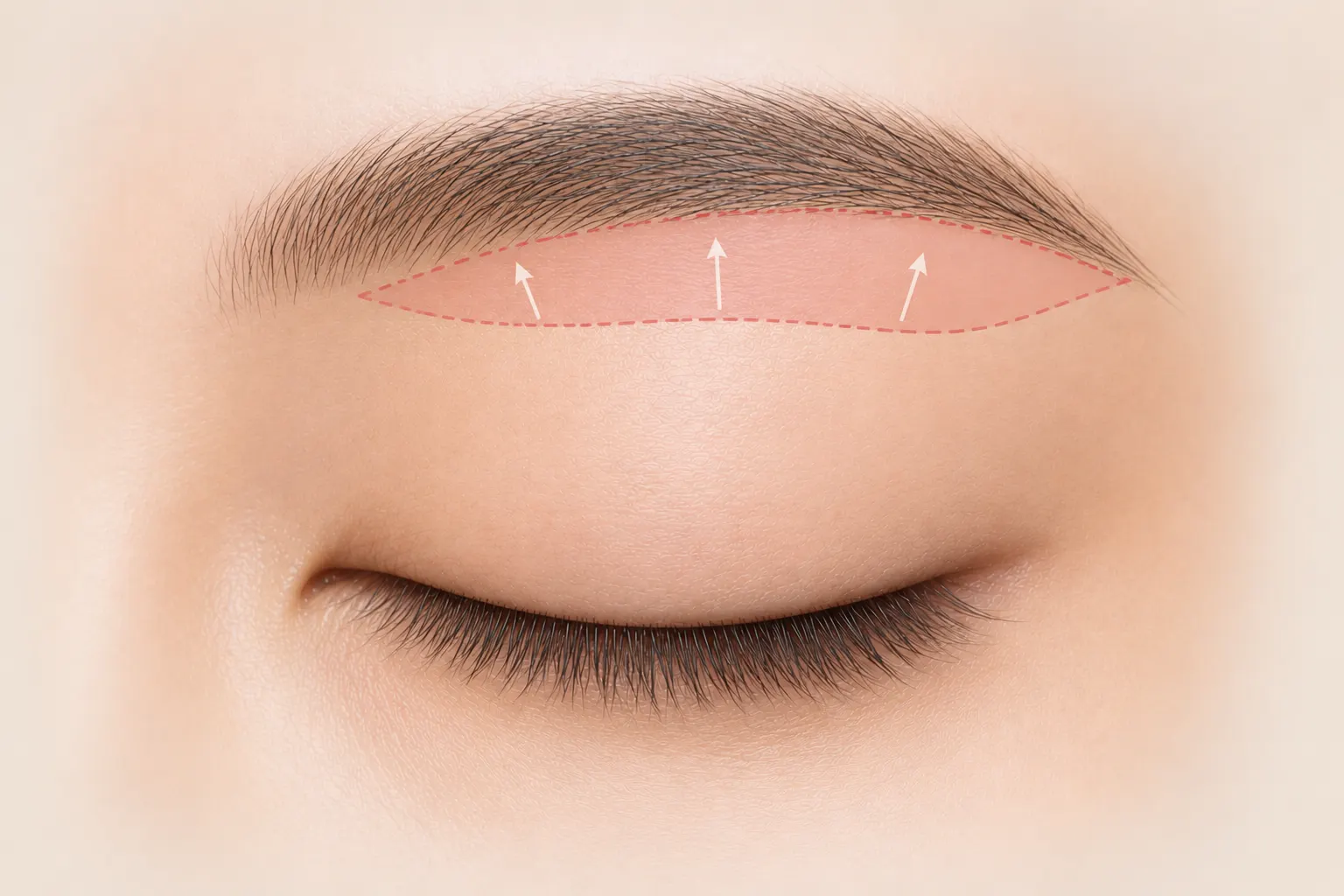
| Incision site | Double eyelid crease | Just below the lower edge of the eyebrow |
| Double eyelid | A new double eyelid crease is created | Your existing eye shape is kept as is |
| Change in appearance | The structure and crease of the eyes change | Minimal |
| Suitable for | Thin skin; crease needs refining | Keeping the existing crease, sagging at the outer corner, thick skin |
| Swelling | Major swelling subsides in 4–6 weeks | Mostly gone in 1–2 weeks |
The method is decided after checking your eyelid skin, eyebrow position and eye-opening strength at consultation.
Quick answer
- Upper blepharoplasty removes sagging eyelid skin through an incision in the double eyelid crease, and a sub-brow lift does so through an incision just below the eyebrow.
- The key question between the two is whether you want to keep your existing eye shape and appearance, or change the structure and crease of your eyes.
- If the eyebrow itself has dropped, removing skin below the eyebrow alone may not solve the problem, so an endoscopic brow lift is also considered.
The biggest difference between the two surgeries is the incision site
Upper blepharoplasty removes sagging eyelid skin through an incision in the double eyelid crease, and a sub-brow lift does so through an incision just below the eyebrow. Put simply, upper blepharoplasty is double eyelid surgery for middle age: it trims loose eyelid skin, muscle and thick fat, and creates a new double eyelid crease in its place. A sub-brow lift removes skin along the lower edge of the eyebrow to lift the drooping eyelid. It is also called subbrow blepharoplasty or infrabrow excision; unlike a direct brow lift, which raises the eyebrow itself, it removes skin just below the eyebrow.
In short, the key question between the two is whether you want to keep your existing eye shape and appearance, or change the structure and crease of your eyes.
When upper blepharoplasty is a good fit
The biggest reason people in middle age hesitate about upper blepharoplasty is worry that they will look harsher or more intense after surgery. The more skin is removed, the greater the change in appearance, so we also consider planning a low, natural crease that accounts for the sagging skin, or using a lighter fixation to reduce the change. If an excessive change in impression is expected, a sub-brow lift or brow lift is considered instead.
In middle age, sagging skin often comes with eyelid ptosis, where the eye-opening muscle has weakened. If only the skin is removed, the eyes may still look sleepy, so we check eye-opening strength before surgery and, if needed, perform ptosis correction through the same incision.
- When the eyelid skin has lost elasticity overall and sags considerably
- When you have no double eyelid and want to create a natural crease this time
- When an existing double eyelid crease has developed extra folds or faded with age and needs refining
- When sagging skin pushes the eyelashes down so they poke the eyes and cause frequent watering
- When the skin is thin
- When an additional procedure such as ptosis correction is needed
When a sub-brow lift is a good fit
A study of 64 Asian women who had a sub-brow lift also listed indications such as wanting to keep the existing double eyelid crease, sagging at the outer corner being the main concern, and having or planning eyebrow tattooing (Kim et al., 2008).
Many men want to trim only the sagging skin without creating a double eyelid, so a sub-brow lift is often a good fit, and it can be considered even in the 20s–30s if excess eyelid skin covers the eyes. However, if the eyebrows are naturally low or the distance between the eyebrow and eye is short, a brow lift may be more suitable.
- When your existing double eyelid crease already looks natural and you want to keep it
- When the skin is thick and you do not want your appearance to change
- When the eyelid skin is thick and upper blepharoplasty is likely to make you look harsher
- When skin at the outer corner of the eye sags so much that it becomes irritated and raw
What about sub-brow lift scars?
Because a sub-brow lift involves a skin incision, it leaves a scar. However, the incision line is placed along the lower edge of the eyebrow, so after healing it is often hidden by the eyebrow or not very noticeable. Early on there may be some redness, which gradually fades over several months, and how visible the scar remains depends on skin type, constitution and aftercare.
If only the skin surface is stitched, the wound may widen over time or the scar may turn white, so we perform layered closure, pulling and securing the tissue step by step starting from the firm fascia layer beneath the skin. This helps the scar stay hidden along the eyebrow line.
If your eyebrows have dropped, we also consider an endoscopic brow lift
If the cause of the drooping eyelid is not the eyelid skin but the eyebrow itself dropping, removing skin below the eyebrow alone may not solve the problem. When the eyebrow position is fine and only the eyelid skin sags, a sub-brow lift is often suitable; when the eyebrow itself has dropped and there are both forehead wrinkles and drooping eyelids, an endoscopic brow lift (forehead lift) is often suitable.
When an endoscopic brow lift and upper blepharoplasty are done together, raising the eyebrow first changes how much eyelid skin is left, so it is important to set the eyebrow position first and then trim only as much eyelid skin as needed.
What do we check at consultation?
In middle-aged eye surgery, a one-size-fits-all choice made without looking at these points together is unlikely to lead to a satisfying result. We suggest deciding based on the condition of your own eyes rather than trends or other people's reviews.
- The thickness of the eyelid skin and how much it sags
- The distance between the eye and the eyebrow
- How much you use your forehead muscles to open your eyes
- Eye-opening strength (whether there is eyelid ptosis)
- How much the outer corner of the eye sags
- Whether you want a double eyelid and how you feel about a change in appearance
Recovery after upper blepharoplasty and a sub-brow lift
For both surgeries, returning to daily life usually takes about 1 week, and stitches are removed 7 days after surgery. Swelling and bruising peak on days 2–3, and you can wash your face from the day after stitch removal. It is best to avoid alcohol, smoking, saunas and strenuous exercise for 4 weeks.
There are differences too. With upper blepharoplasty, major swelling takes about 4–6 weeks to go down, and makeup on the incision area and contact lenses are possible after 4 weeks. With a sub-brow lift, swelling and bruising are mostly gone in about 1–2 weeks, and it is best to avoid eyebrow makeup and tattooing for 4 weeks.
FAQ
Can droopy eyelids improve with exercise or massage?
Droopy eyelids are difficult to improve with exercise or massage. Stretched skin and loosened tissue do not shrink with exercise, and rubbing around the eyes often may actually irritate the skin. If the drooping blocks your vision or makes your eyes look sleepy, we identify the cause and consider surgical correction.
Can upper and lower blepharoplasty be done at the same time?
Upper and lower blepharoplasty can be done together. When there is both upper eyelid sagging and under-eye fat or sagging, doing them at once means only one recovery period. However, the surgery takes longer and swelling may be greater, so we decide whether to combine or separate them after checking your health and the condition of your eyes.
What are the possible side effects of a sub-brow lift?
After a sub-brow lift, besides temporary swelling, bruising and reduced sensation around the incision, the scar may rarely widen or become raised, and left-right asymmetry or a change in eyebrow shape can occur. Reduced sensation usually recovers over several months, and scarring varies with constitution and aftercare. It is important to accurately assess the eyebrow position and degree of skin sagging before surgery to decide how much to remove.
References
- Kim YS, Roh TS, Yoo WM, Tark KC, Kim J. Infrabrow excision blepharoplasty: applications and outcomes in upper blepharoplasty in Asian women. Plast Reconstr Surg. 2008;122(4):1199-1205. doi:10.1097/PRS.0b013e3181858fc0 PMID 18827656
- 박대환, 백봉수, Nahai F. 안성형외과학. 제3판. 군자출판사; 2009. ISBN 978-89-6278-139-7. [in Korean]
- Cho I. The Art of Blepharoplasty. Koonja Publishing; 2017. ISBN 979-11-5955-234-2.
- 대한미용성형외과학회. 미용성형외과학 2. 제2판. 군자출판사; 2023. ISBN 979-11-7068-001-7. [in Korean]
Have questions?